
Book 6, Question 15
Why Do Waves Get Bigger Near Shore?
Waves get bigger near shore because the shallow seafloor slows the bottom of the wave, so it stands taller until it breaks.
In deep water, a wave is a long, low shape. Near shore, the bottom crowds it from below. So the wave stands taller, until it breaks.
Watch the videoWatch on YouTubeSee the series on Amazon
Quick answers
How much taller can waves get?
Near shore, waves can grow up to 1.5 times as tall as they were in deep water, then break as surf.
Sources: National Park Service, NOAA, NOAA Ocean Service
From the book
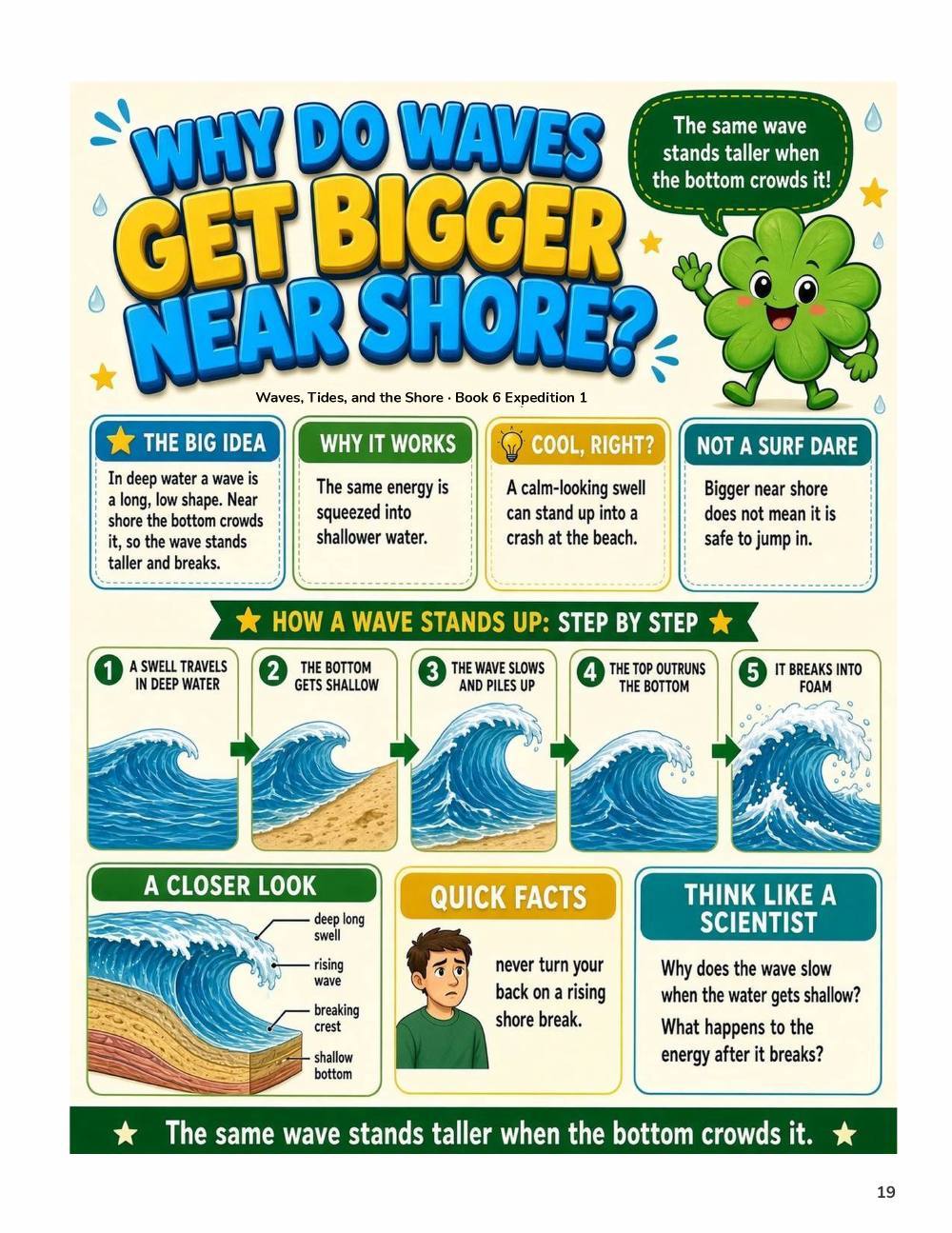
Page from A Million Whys Book 6
More fun facts
- When the water gets shallower than half a wave's length, the seafloor starts to slow the bottom of the wave.
- Near shore, waves can grow up to 1.5 times as tall as they were in deep water, then break as surf.
- In the deep ocean, the wave shape moves forward but the water itself barely does.
- After a wave breaks, water rushes up the beach as swash and slides back down as undertow.
- A wave's energy gets used up by breaking, by making new waves or currents, and by moving sand.
- Storm surge is a series of long waves made far out at sea that grow stronger as they near the coast.
Sources: National Park Service, NOAA, NOAA Ocean Service
Questions kids ask
What is undertow?
It is water from a broken wave sliding back down the beach toward the sea.