
Book 5, Question 147
Layer by Layer! Why Are Older Layers Usually Lower?
Older layers are usually lower because they were laid down first and newer layers settled on top.
New layers of mud and sand usually settle on top of ones that were already there. So in many places, the bottom layers are the oldest and the top layers are the newest. Geologists use this idea to work out the order of past events.
Watch the videoWatch on YouTubeSee the series on Amazon
Quick answers
What is this idea called?
Geologists call this idea the principle of superposition.
Sources: National Park Service, National Park Service, U.S. Geological Survey, NASA Science
From the book
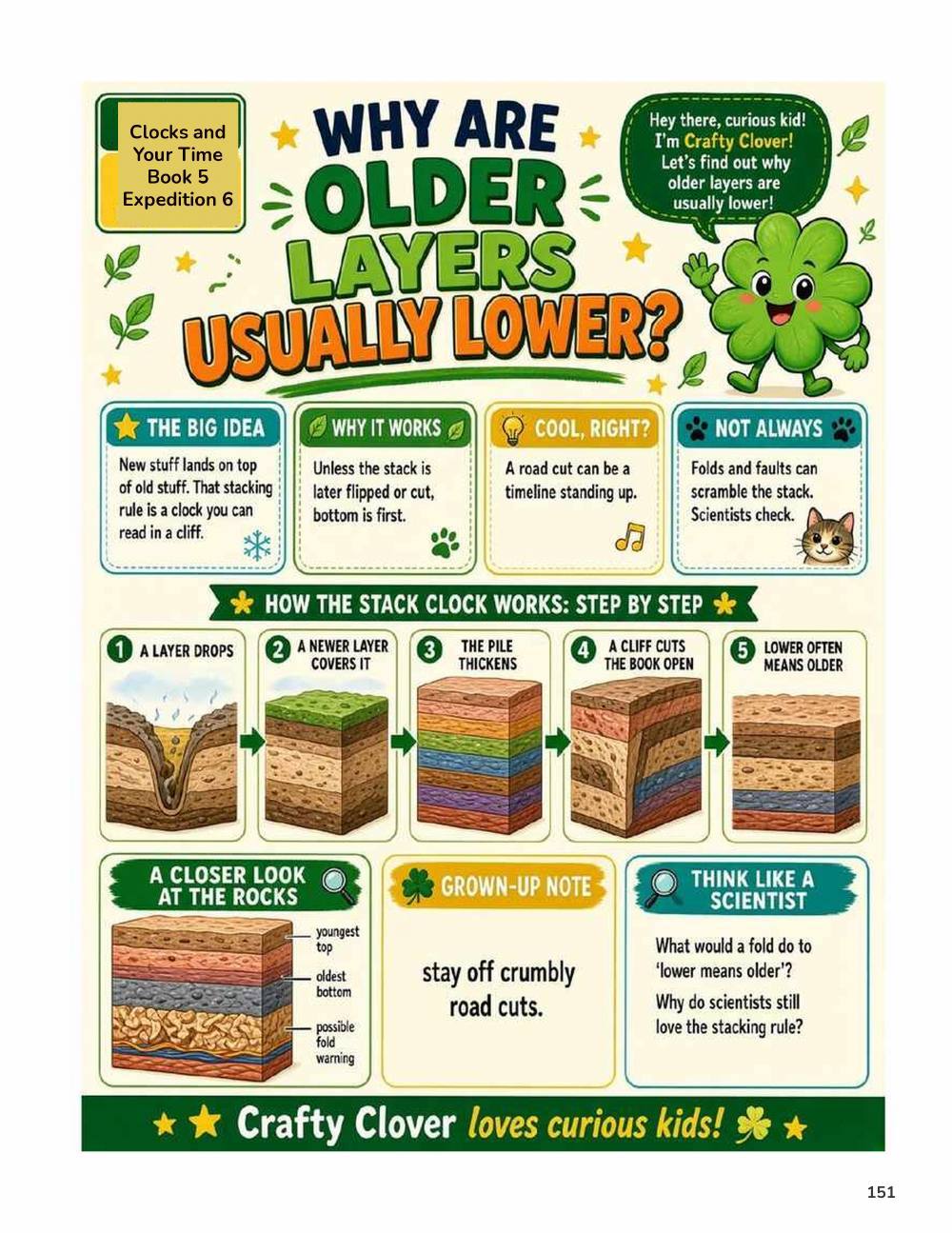
Page from A Million Whys Book 5
More fun facts
- The oldest rock layers are at the bottom because they were laid down first.
- Geologists call this idea the principle of superposition.
- In any stack of layered rocks, each layer must be older than the layers on top of it.
- On Mars, the layers of a mound in Gale Crater go from older at the bottom to younger at the top, and may record how Mars dried out.
- At Colorado National Monument, all the rocks are sedimentary, made from sand and mud, except the very bottom layer.
Sources: National Park Service, National Park Service, U.S. Geological Survey, NASA Science
Questions kids ask
What is superposition?
It is the idea that in a stack of rock layers, the lower layers are older than the ones above them.