
Book 5, Question 27
Layer Cake Earth! Why Are Fossils Found in Rock Layers?
Fossils are found in rock layers because mud and sand settle in layers that bury animals and slowly harden into rock.
Mud, sand, and tiny bits of rock settle in layers, and those layers can harden into rock. An animal buried in a layer may become a fossil, which is why fossils are found in this kind of rock. Layers help scientists tell which fossils are older and which are younger.
Watch the videoWatch on YouTubeSee the series on Amazon
Quick answers
Which layers are older?
Lower layers are usually older than the layers above them.
What does mud turn into?
Sand becomes sandstone and mud becomes mudstone or shale.
Sources: U.S. Geological Survey, NASA, U.S. Geological Survey
From the book
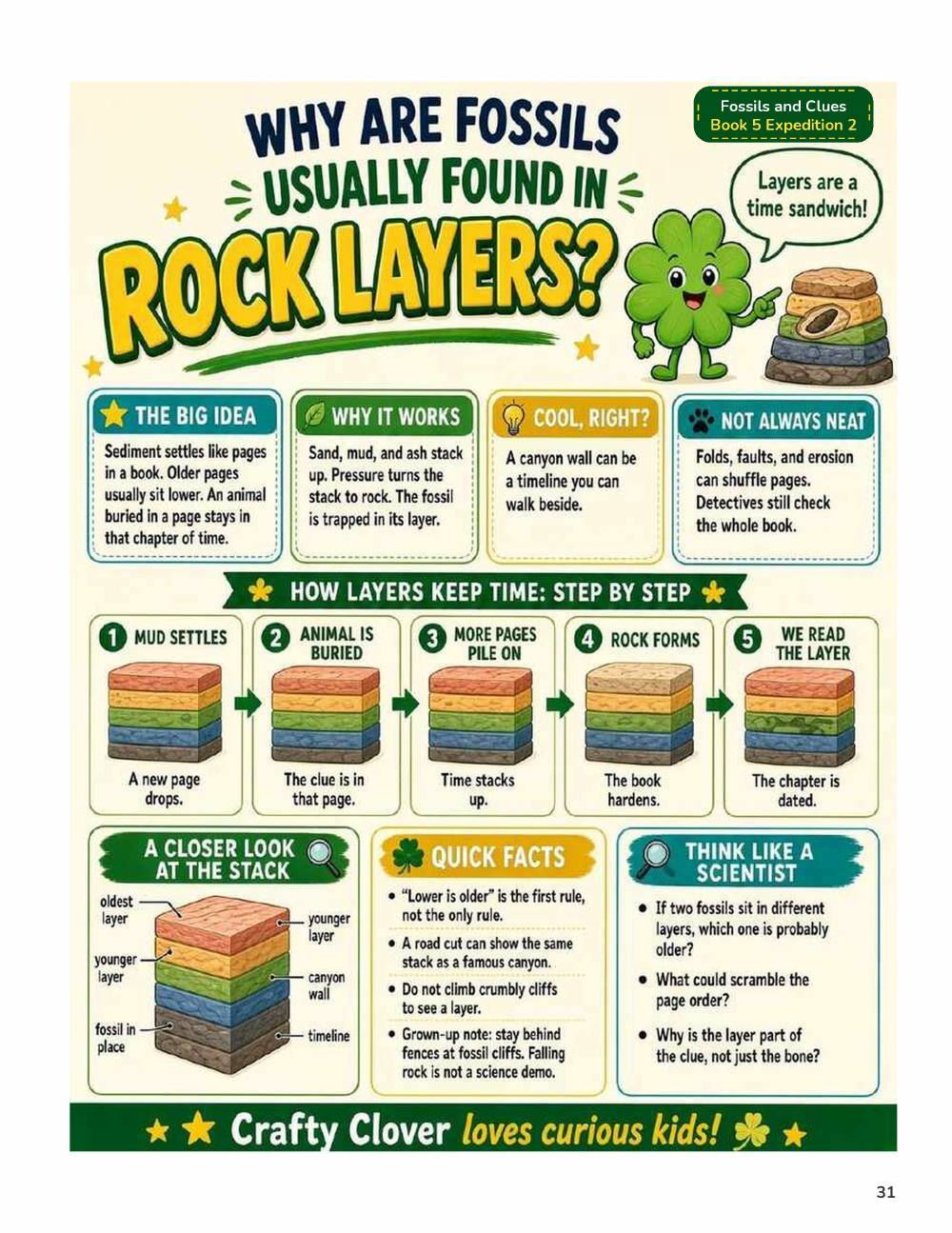
Page from A Million Whys Book 5
More fun facts
- Most rocks at Earth's surface are sedimentary, made from bits of older rock broken apart by water or wind.
- Gravel, sand and mud settle to the bottom of rivers, lakes and oceans and can bury plants and animals.
- Over time the bottom layers turn to rock: sand becomes sandstone and mud becomes mudstone or shale.
- The layers work like pages in a history book. Lower layers are usually older than the layers above them.
- In the 1600s, the Danish scientist Nicolas Steno studied how rock layers stack up.
- More than 200 years ago, William Smith, a canal engineer in England, named 23 rock layers by their color, hardness and fossils.
Sources: U.S. Geological Survey, NASA, U.S. Geological Survey
Questions kids ask
How do layers tell scientists how old a fossil is?
Layers pile up over time, so fossils in lower layers are usually older than fossils in higher layers.