
Book 3, Question 84
Why Do TVs Show Moving Pictures?
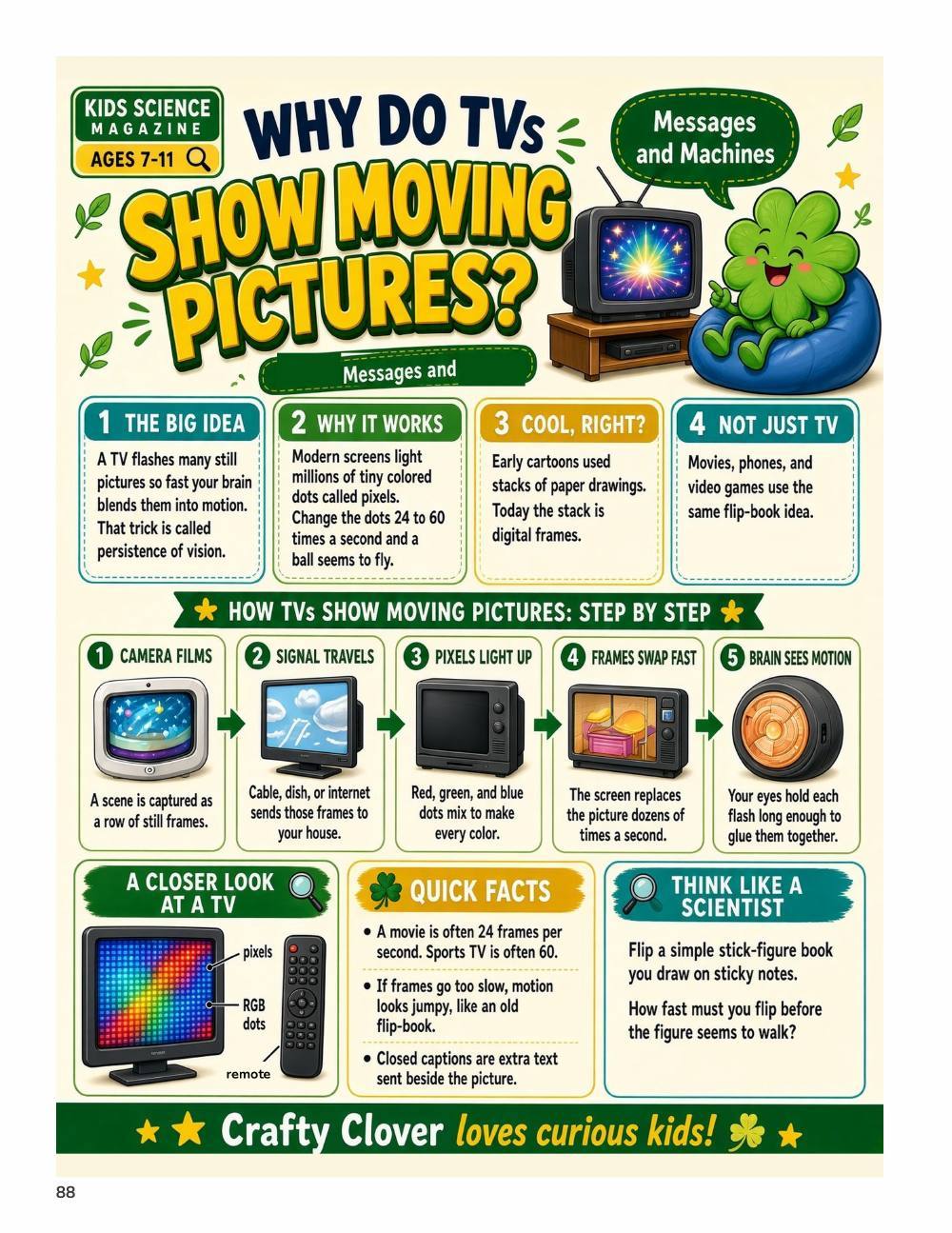
TVs show moving pictures by showing many still pictures one after another so fast that the brain sees movement.
A TV shows lots of still pictures, one after another, so fast that your brain blends them into motion. This is called persistence of vision. Modern screens use millions of tiny colored dots called pixels, and they change 24 to 60 times every second!
Watch the videoWatch on YouTubeBuy on Amazon
Quick answers
How does the brain see motion?
When a picture shifts a little from one frame to the next, motion-sensing cells in your brain see it as movement.
Sources: Scientific American, National Geographic, BBC
From the book
Page from A Million Whys Book 3
More fun facts
- Moving pictures on a screen are really lots of still pictures shown one after another.
- When a picture shifts a little from one frame to the next, motion-sensing cells in your brain see it as movement.
- Inventions of the 1800s like the telegraph, the telephone and the movie camera inspired engineers to find a way to send pictures.
- In an early television demonstration by John Logie Baird, viewers saw a flickering moving image of a ventriloquist's dummy.
- At first, electrical systems were not powerful enough to send the huge amount of data a moving picture needs.
- Today, TV pictures and sound are turned into waves and can be sent around the country by satellite.
Sources: Scientific American, National Geographic, BBC
Questions kids ask
Are TV pictures really moving?
Not exactly. TVs show many still pictures very quickly, and your brain blends them into smooth motion.