
Book 1, Question 126
Why Does Bread Rise? Meet the Tiny Yeast Helpers!
Bread rises because yeast, tiny living fungi, eat sugar in the dough and make gas bubbles that the stretchy dough traps.
Bread puffs up because of tiny living helpers! Yeast are living microbes that eat sugar and make carbon dioxide gas, and the stretchy dough traps the bubbles so the loaf puffs. The page says a teaspoon of yeast can hold hundreds of millions of cells. Mix warm water, sugar and yeast in a cup and watch for foam!
Watch the videoWatch on YouTubeBuy on Amazon
Quick answers
What are the holes in bread?
They are left by gas bubbles made by yeast.
Can old yeast still work?
Scientists woke up 4,500-year-old yeast from ancient Egyptian pottery, and a baker made bread with it.
Sources: Science News Explores, National Geographic, Smithsonian Magazine
From the book
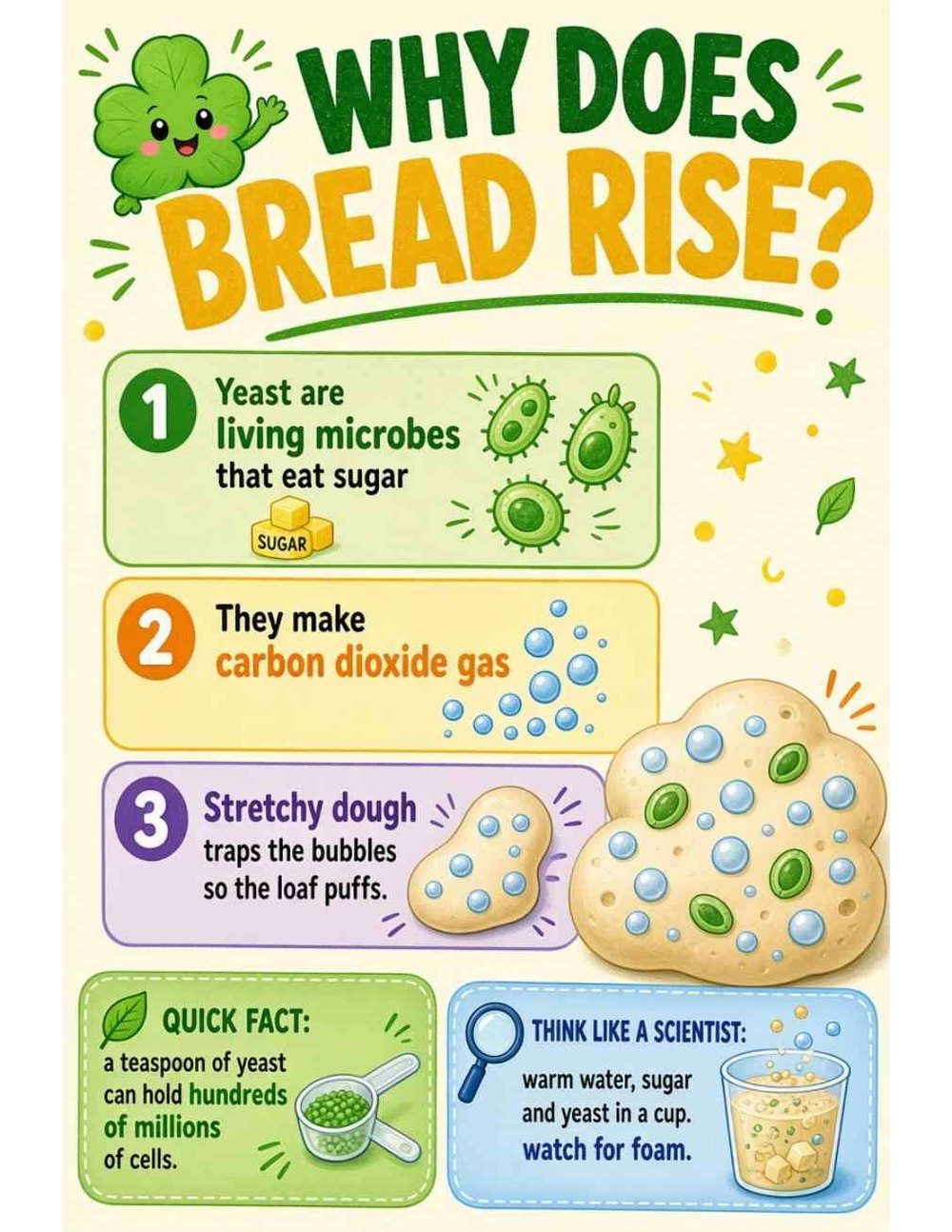
Page from A Million Whys Book 1
More fun facts
- Yeast are tiny living things called single-celled fungi.
- Yeast are very common in the environment, and most kinds are harmless.
- The holes you see in a slice of bread are left by bubbles of gas that yeast made.
- Store-bought baker's yeast did not become common until the late 1800s.
- Scientists woke up 4,500-year-old yeast from ancient Egyptian pottery, and one baker used it to make bread.
- Yeast also help make some drinks, and scientists use yeast to study how genes work.
Sources: Science News Explores, National Geographic, Smithsonian Magazine
Questions kids ask
Is yeast alive?
Yes. Yeast are tiny single-celled fungi.
What makes the holes in bread?
Bubbles of carbon dioxide gas made by yeast.