
Book 1, Question 113
How Do Clocks Keep Time? Ticks, Swings and Crystals!
Clocks keep time by counting something that repeats at a steady rate, like a swinging pendulum, a vibrating quartz crystal or energy given off by atoms.
A clock counts equal ticks, and that is how it keeps time. Old clocks used swinging pendulums to count, and many clocks now count tiny crystal vibrations. The page says a second is a counted slice of time. Count 60 claps and compare them with a clock to see how close you get!
Watch the videoWatch on YouTubeBuy on Amazon
Quick answers
How does a quartz clock work?
A quartz crystal vibrates at a very precise speed when electricity is applied, ticking like a tiny pendulum.
How accurate are atomic clocks?
A small atomic clock built for a satellite might drift by only about one second in 30,000 years. Many atomic clocks use an element called cesium.
Sources: NASA, NASA, NOAA Ocean Service
From the book
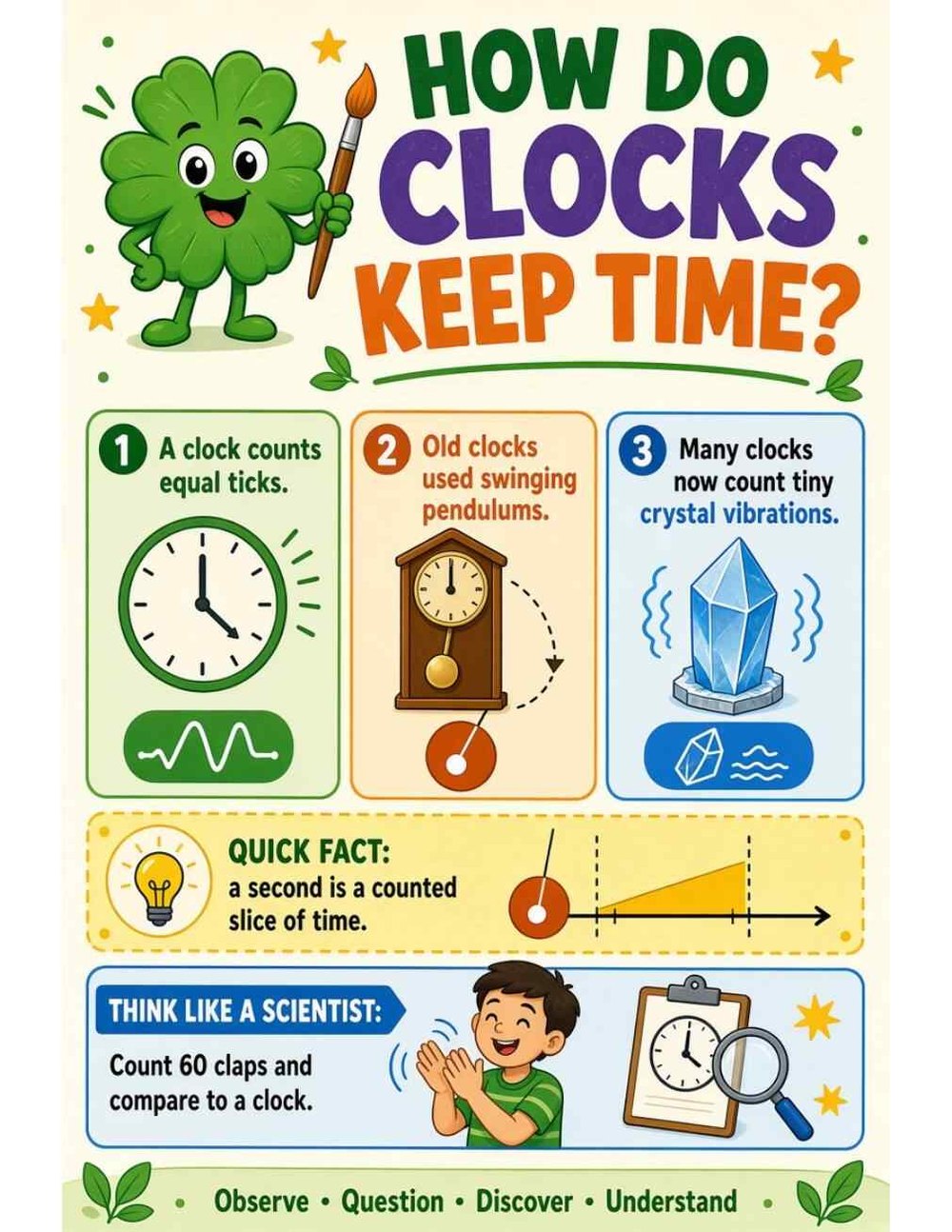
Page from A Million Whys Book 1
More fun facts
- Most modern clocks, from wristwatches to satellites, keep time with a quartz crystal.
- A quartz crystal vibrates at a very precise speed when electricity is applied to it, ticking like a tiny pendulum.
- Even the best quartz clocks can drift by about a billionth of a second in an hour, which matters for spacecraft navigation.
- Atomic clocks keep time using atoms, which give off energy at a steady, measurable rate.
- Many atomic clocks use an element called cesium.
- A small atomic clock built for a satellite might drift by only about one second in 30,000 years.
- Scientists at NIST are building atomic clocks so accurate that effects from Einstein's theory of relativity show up in them.
Sources: NASA, NASA, NOAA Ocean Service
Questions kids ask
What keeps time inside a watch?
Most watches use a tiny quartz crystal that vibrates at a steady speed.
What is an atomic clock?
A clock that keeps time by measuring the steady energy given off by atoms, like cesium.