
Book 1, Question 112
Why Do Echoes Bounce? Sound Bounces Back Late!
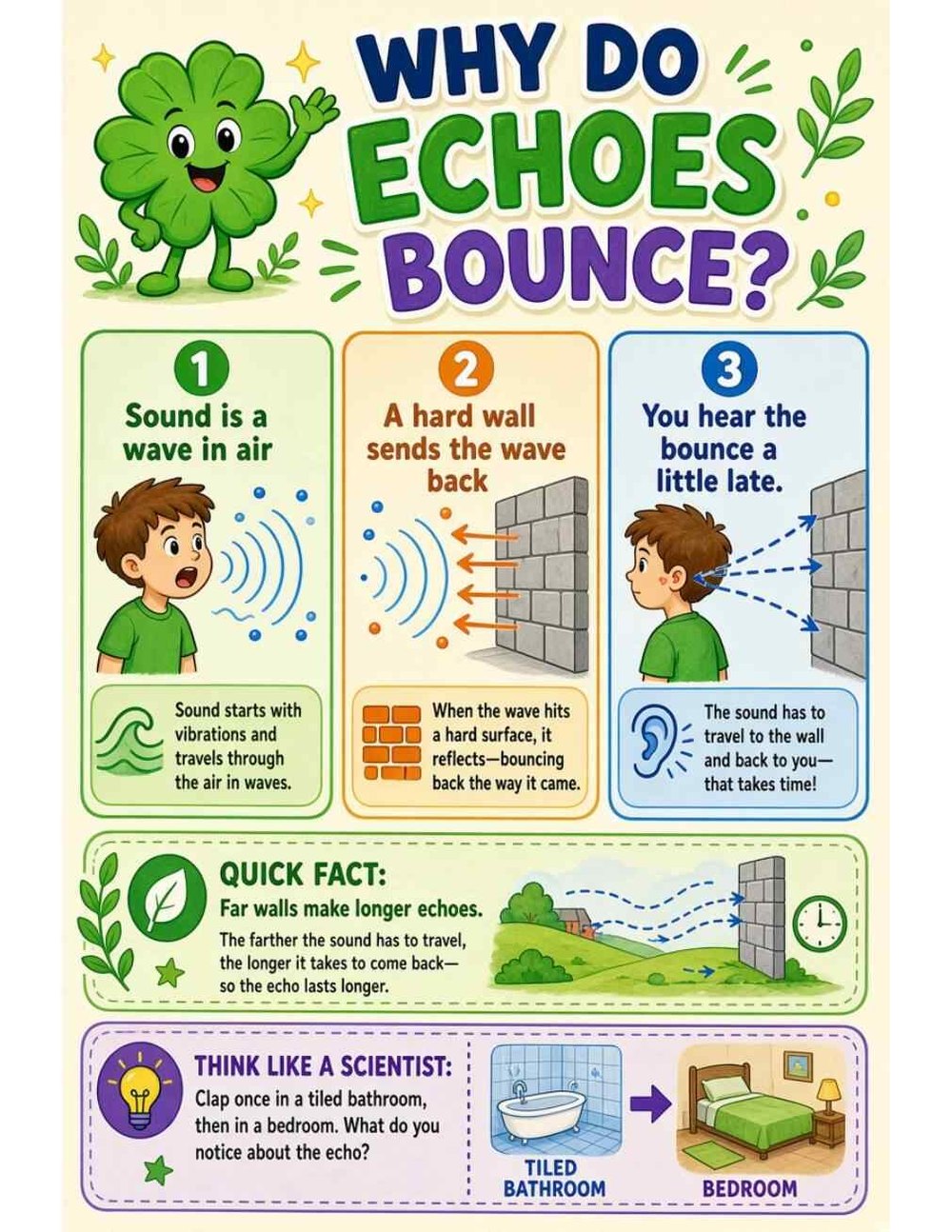
Shout at a far wall and your voice comes back to you! Sound starts with vibrations and travels through the air in waves, and when a wave hits a hard surface it reflects, bouncing back the way it came. You hear the bounce a little late because the sound has to travel to the wall and back, which takes time. The page says far walls make longer echoes. Clap once in a tiled bathroom and then in a bedroom and compare the echo.
From the book
Page from A Million Whys Book 1
More fun facts
- Sound travels through air at about 760 miles per hour, or about 1,100 feet every second.
- You can tell how far away lightning is by counting the seconds between the flash and the thunder, because light arrives almost instantly but sound is slower.
- Bats find food in the dark by calling out and listening for echoes. This is called echolocation.
- Most bat calls are too high-pitched for people to hear.
- A bat can tell how far away a bug is by timing how long the echo takes to come back.
- Using echolocation, a big brown bat can swoop down, catch a bug and eat it in about 2 seconds.
- Ships use sonar, which sends sound pulses into the water and listens for echoes, to map the seafloor and find shipwrecks.
Sources: NASA, Science News Explores, NOAA Ocean Service
Questions kids ask
How do bats use echoes?
They make high calls and listen to the echoes to find bugs and objects in the dark.
What is sonar?
A tool that sends sound into the water and listens for echoes to find and map things underwater.