
Book 3, Question 96
Why Do Video Calls Show Faces Far Away?
Video calls show faces far away by squeezing video into data, sending it over the internet, and rebuilding it on the other device.
A video call is a conversation made of pictures and sound, chopped into tiny packets that race through the internet. A camera snaps many still pictures. Software squeezes them into data, and the other device rebuilds them so they look like motion.
Watch the videoWatch on YouTubeBuy on Amazon
Quick answers
How much is video squeezed?
Modern video compression squeezes it about 375 times smaller.
Sources: blog.webex.com, Stanford
From the book
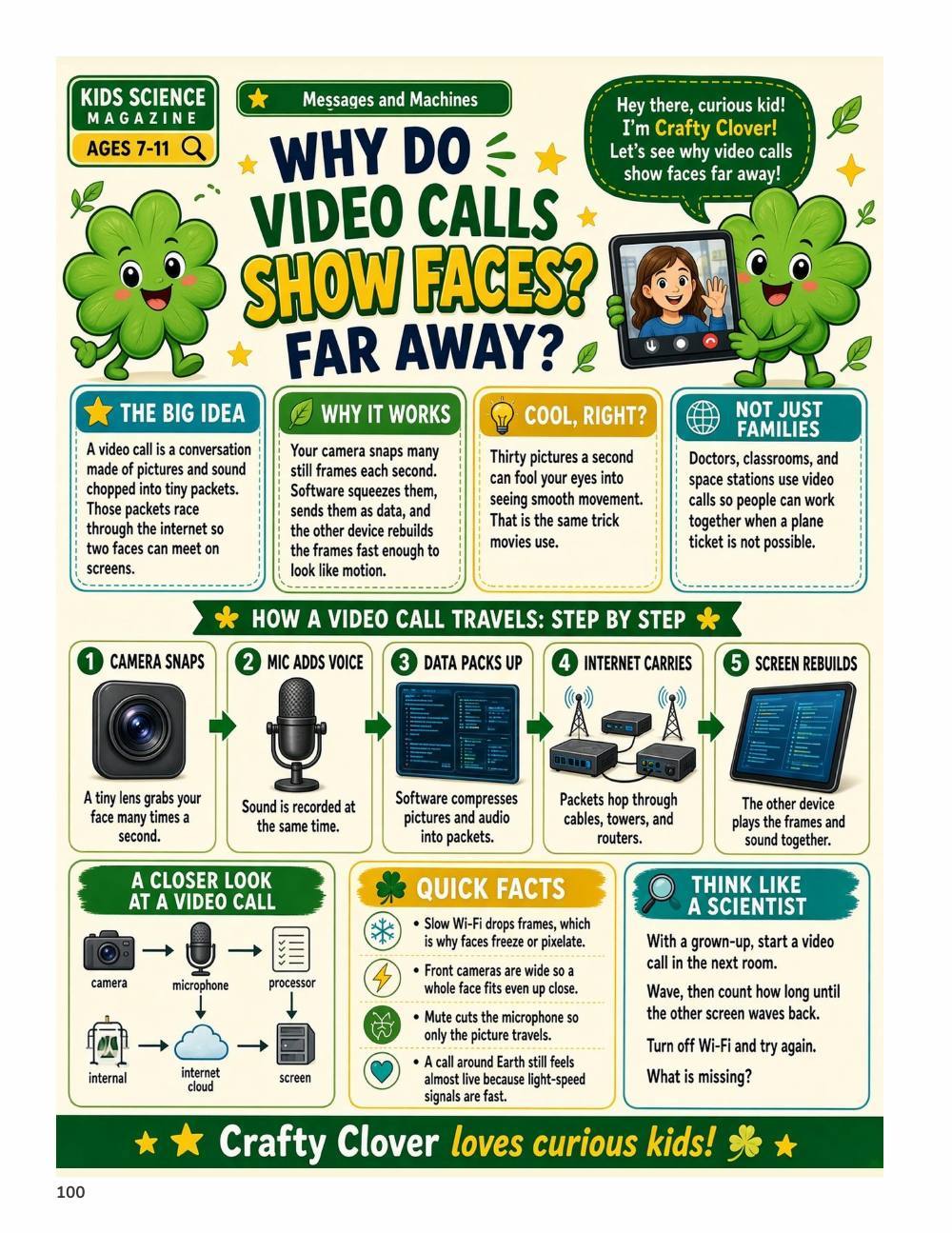
Page from A Million Whys Book 3
More fun facts
- Raw high definition video at 30 frames a second would need about 1.5 billion bits every second.
- Modern video compression squeezes that down to about 4 million bits a second, about 375 times smaller.
- A 20 second high definition clip that would fill 3.5 gigabytes raw can shrink to about 27 megabytes.
- Most frames in a video call do not hold a whole picture. They hold only what changed since the frame before.
- Frames are usually just 33 thousandths of a second apart, so the changes between them are small.
- Now and then, a full picture called a keyframe is sent.
- If lost data ruins one frame, the frames after it go wrong too, so the receiver asks for a new keyframe.
- While it waits, the picture may freeze or show strange smears.
Sources: blog.webex.com, Stanford
Questions kids ask
Why does a video call sometimes freeze?
When data gets lost, the next frames cannot be rebuilt, so the picture may freeze until a new full picture called a keyframe arrives.