
Book 3, Question 38
Why Does a Kettle Whistle?
A kettle whistles because fast steam escaping through holes in the whistle wobbles the air.
Boiling water makes steam. The steam must escape through a small spout hole. Fast steam wobbles the air, and that wobble is a whistle.
Watch the videoWatch on YouTubeBuy on Amazon
Quick answers
Who studied the whistle?
Scientists at the University of Cambridge built experimental kettles to find out how it works.
Sources: Smithsonian Magazine, Scientific American
From the book
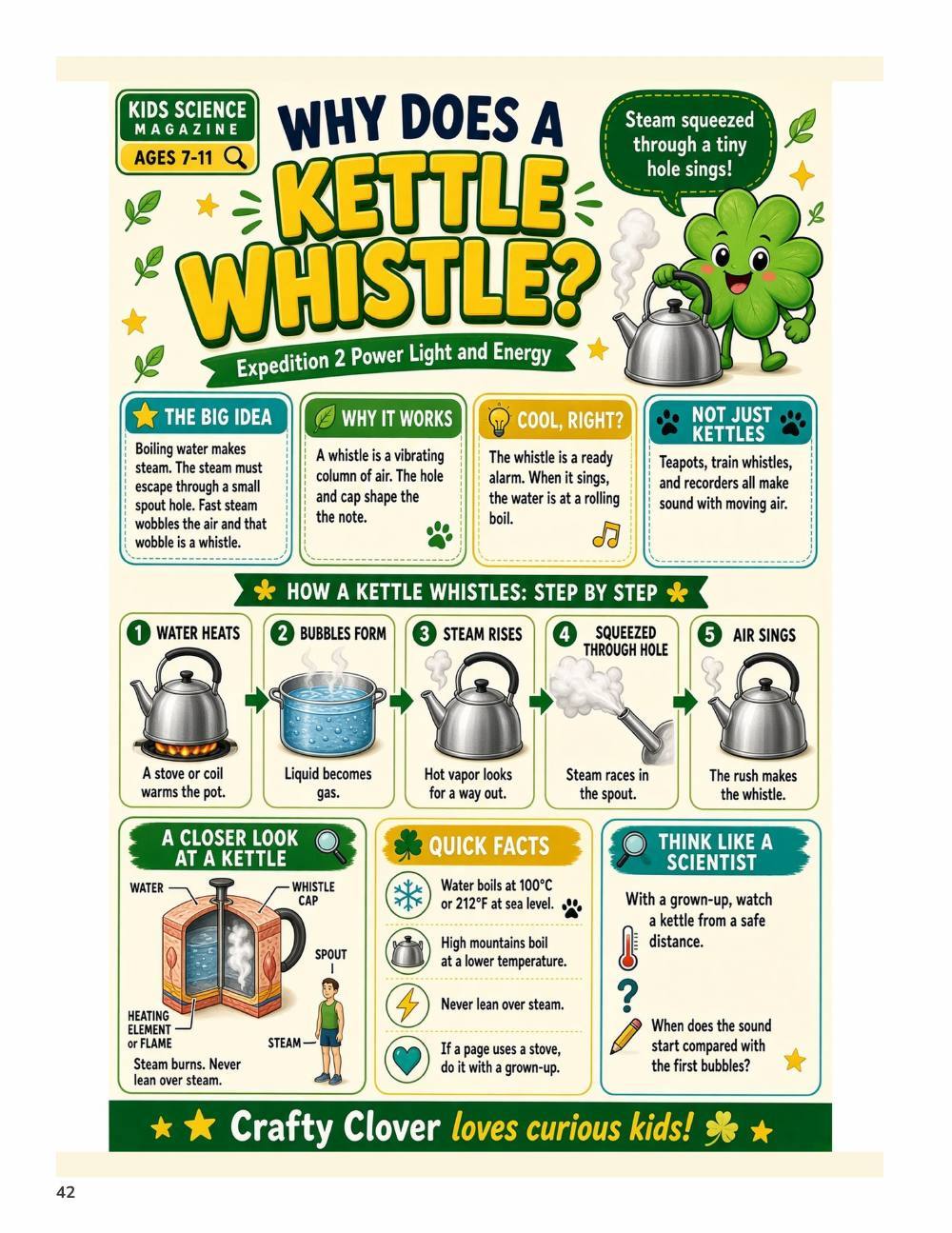
Page from A Million Whys Book 3
More fun facts
- A kettle whistle has two plates with holes, held a short distance apart inside a short tube.
- Scientists at the University of Cambridge built experimental kettles to find out exactly how the whistle works.
- Above a certain speed, the steam forms tiny swirls called vortices, and those swirls make the sound.
- A kettle actually whistles in two different ways.
- More than a century ago, the famous scientist Lord Rayleigh puzzled over how kettles whistle.
- Knowing how the whistle works could help engineers stop annoying whistles in household pipes and damaged car exhausts.
Sources: Smithsonian Magazine, Scientific American
Questions kids ask
What makes the sound in a kettle whistle?
Fast steam rushing through the whistle forms tiny swirls called vortices, and those swirls make the sound.