
Book 3, Question 20
Why Do Parachutes Work?
Parachutes work because their wide canopy makes air resistance, called drag, that slows a fall to a safe speed.
A parachute is a giant air brake. It makes a wide surface that slams into many air molecules, so the fall slows down to a safe speed. The canopy also traps a cushion of air underneath that pushes up against the fall!
Watch the videoWatch on YouTubeBuy on Amazon
Quick answers
Does a parachute keep speeding up?
No. After a moment, it drops at a steady speed.
Sources: Scientific American, Exploratorium, Science News Explores
From the book
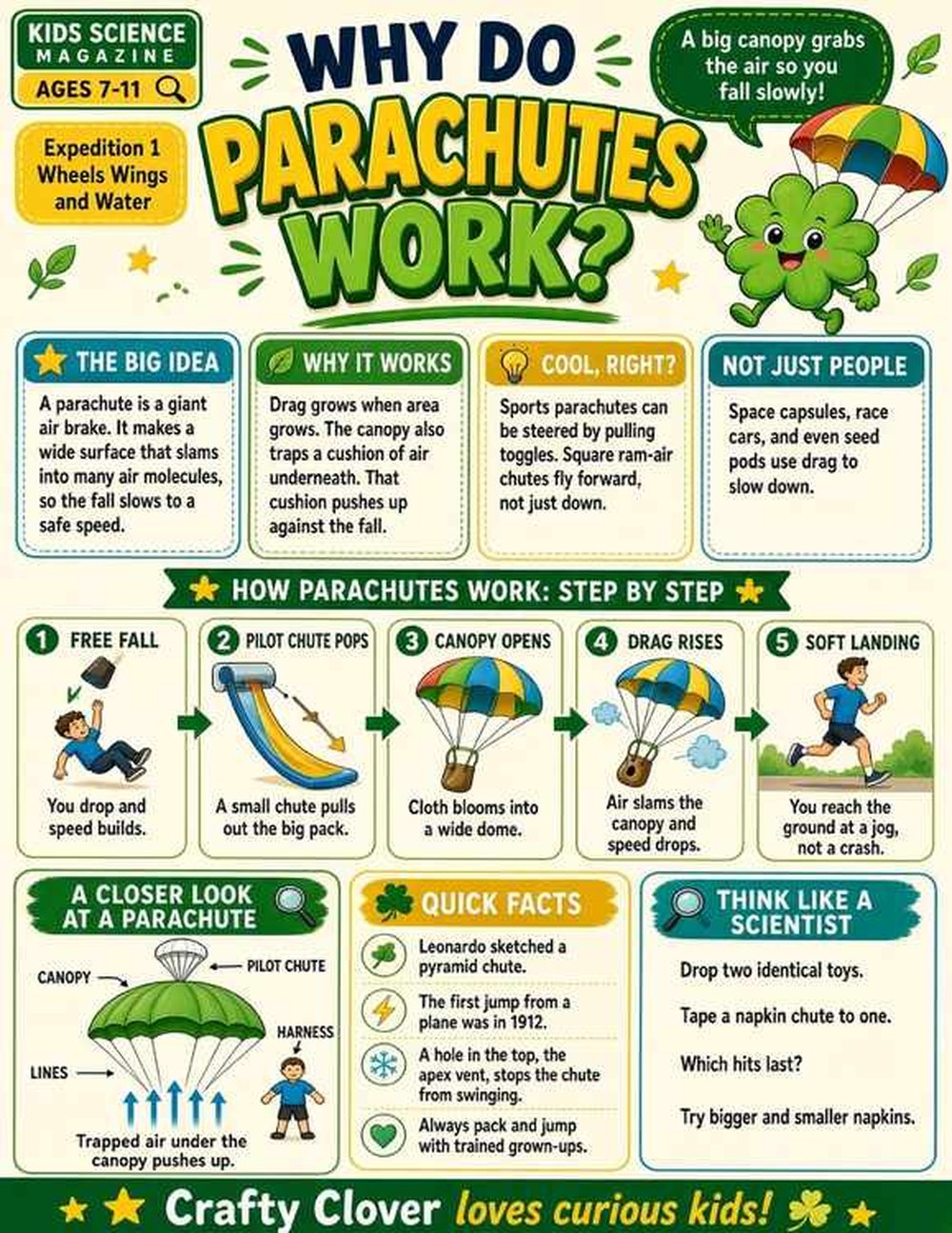
Page from A Million Whys Book 3
More fun facts
- A parachute slows a fall by making air resistance, also called drag.
- The air pushes up on the parachute, opposite to the pull of gravity.
- After a moment, a falling parachute stops speeding up and drops at a steady speed.
- Parachutes come in many shapes and sizes, but they all work on the same basic ideas.
- In skydiving, a person jumps from a plane very high up, falls through the air, then opens a parachute to land safely.
Sources: Scientific American, Exploratorium, Science News Explores
Questions kids ask
Why does a parachute fall at a steady speed?
As it falls faster, the air pushes back harder. Soon the push of the air balances the pull of gravity, so the speed stops increasing.