
Book 3, Question 3
Why Do Boats Float?
Boats float because they push aside, or displace, an amount of water that weighs the same as the boat.
Floating is a push contest. If that upward push is at least as big as the boat's weight, the boat floats!
Watch the videoWatch on YouTubeBuy on Amazon
Quick answers
Why does a steel ship float but a nail sinks?
The ship's shape holds lots of air, making the whole ship less dense than water.
Sources: Scientific American, BBC, NOAA Ocean Service
From the book
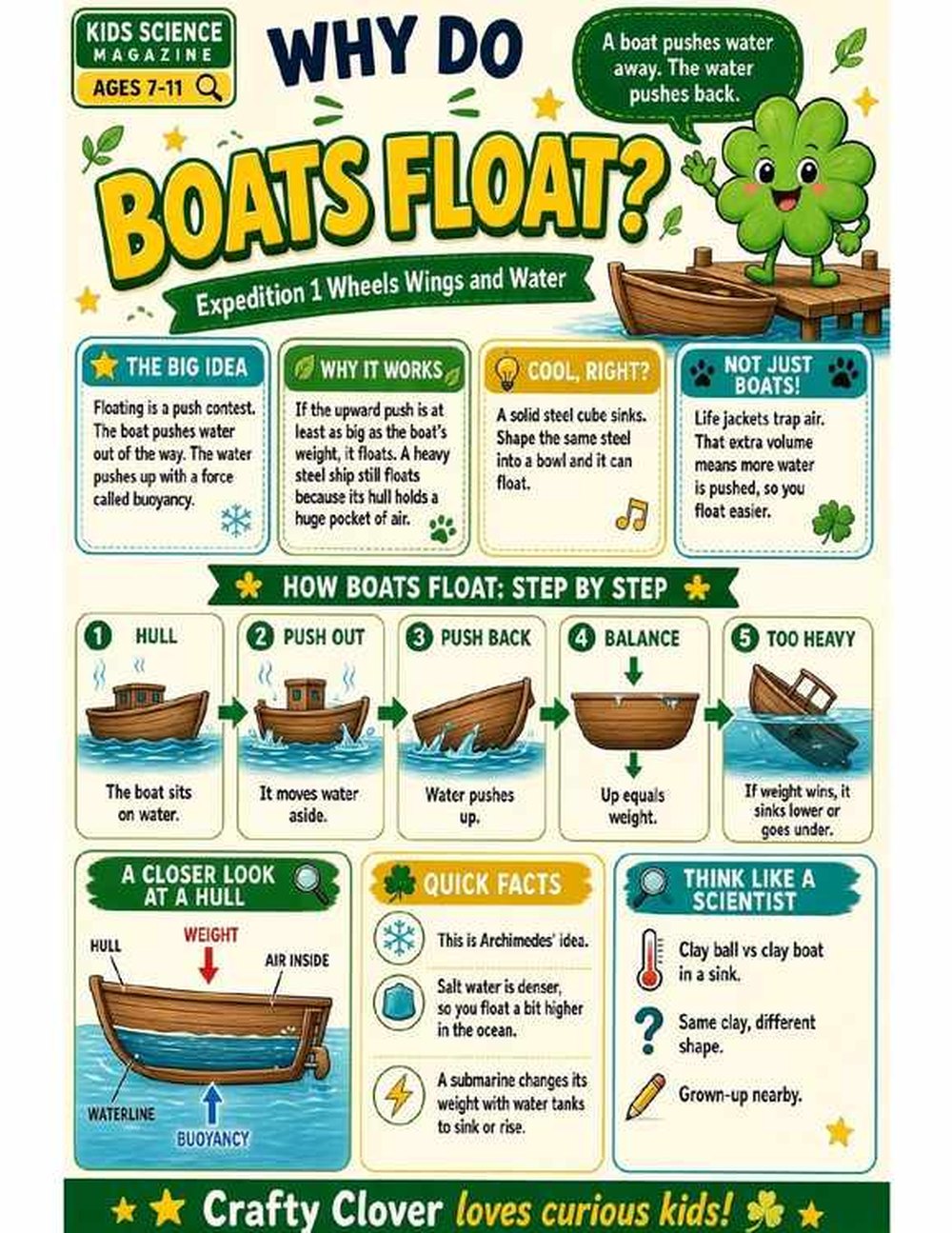
Page from A Million Whys Book 3
More fun facts
- A floating object pushes aside, or displaces, an amount of water that weighs the same as the object.
- A steel nail sinks, but a giant steel ship floats, because the ship's shape holds lots of air and makes the whole ship less dense than water.
- Objects that float on water are called buoyant.
- Paper boats float because they are less dense than water.
- If something is less dense than water, the upward push from the water, called upthrust, is bigger than its weight, so it floats.
- The oldest known boats are dugout canoes.
- You can test this at home: a flat sheet of aluminum foil folded into a boat shape can float while carrying a load of pennies.
Sources: Scientific American, BBC, NOAA Ocean Service
Questions kids ask
Why does a steel ship float when a steel nail sinks?
The ship's shape holds a lot of air, so the whole ship is less dense than water. It pushes aside water that weighs as much as the ship does.