
Book 1, Question 81
Why Is Space Black? A Big Question With a Bright Answer!
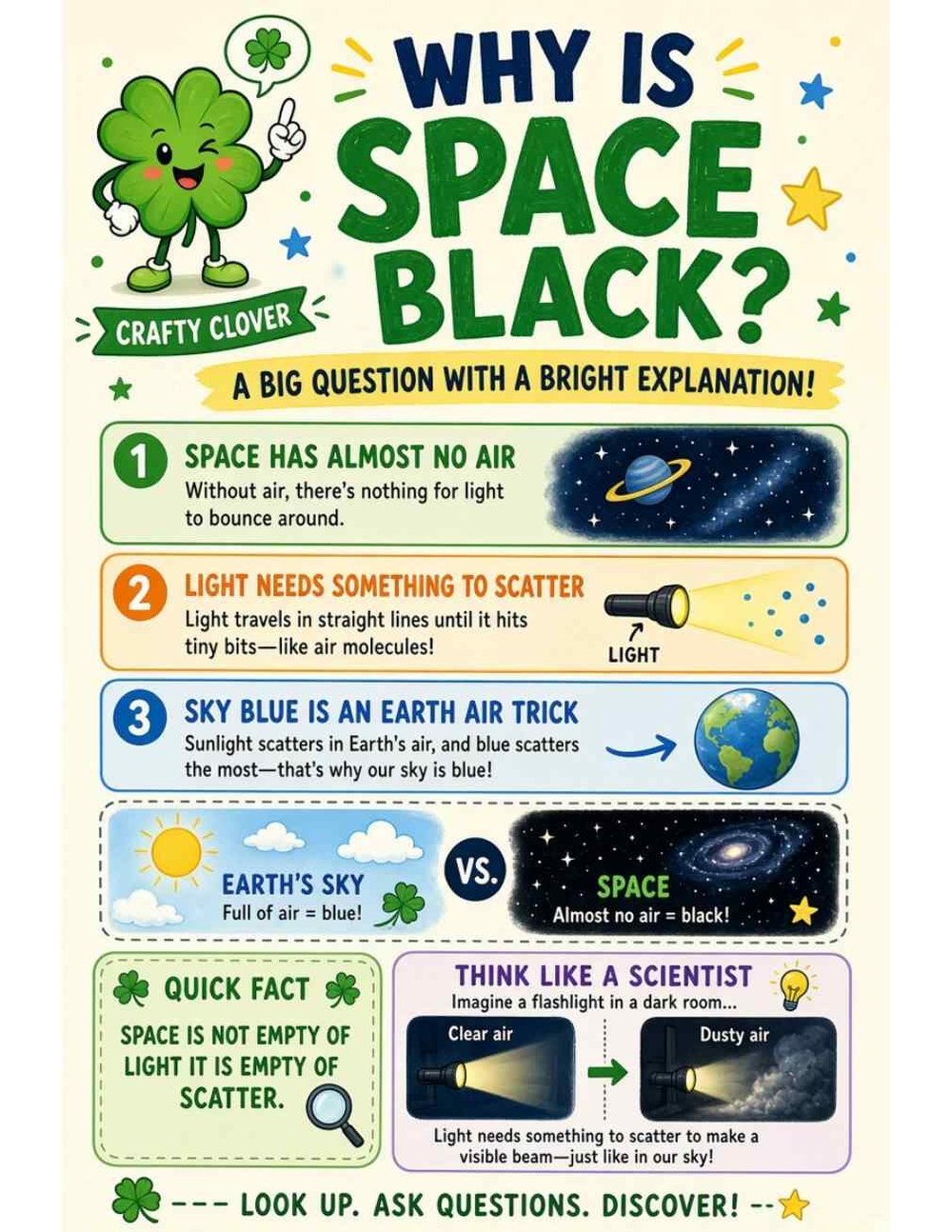
Space is full of stars, so why is it black? The page explains that space has almost no air, and light travels in straight lines until it hits tiny bits, like air molecules, that scatter it. Our blue sky is an Earth-air trick, since sunlight scatters in our air and blue scatters the most. It puts it like this: space is not empty of light, it is empty of scatter. Imagine a flashlight beam in clear air versus dusty air to see the idea.
From the book
Page from A Million Whys Book 1
More fun facts
- Away from city lights, the sky between the stars already looks very dark.
- Above Earth's atmosphere, space gets even darker, an inky pitch black.
- Space is not totally dark. There is a very faint glow from countless distant stars and galaxies.
- NASA's New Horizons spacecraft, far out past Pluto, measured that faint background glow.
- Near the Sun there is a soft band of light called zodiacal light. It is sunlight bouncing off dust in space.
- Hubble observations suggested there may be about two trillion galaxies in the universe, and most are too faint for Hubble to see in visible light.
Sources: NASA Science
Questions kids ask
Is space completely dark?
Almost, but not totally. There is a very faint glow from countless distant stars and galaxies.
How many galaxies are there?
One estimate based on Hubble observations suggests about two trillion.