
Book 1, Question 80
Why Do Stars Twinkle? Wiggly Air Between Us and Space!
Light from a star starts as a tiny point far out in space. When it passes through layers of moving air in Earth's atmosphere, the air bends and wiggles the light, and that is the twinkle. Planets are closer and look like tiny disks instead of points, so their light averages out and they usually shine more steadily. The page says astronauts above Earth's air see steady stars. Tonight, look at a star and a bright planet and compare how much each one twinkles.
From the book
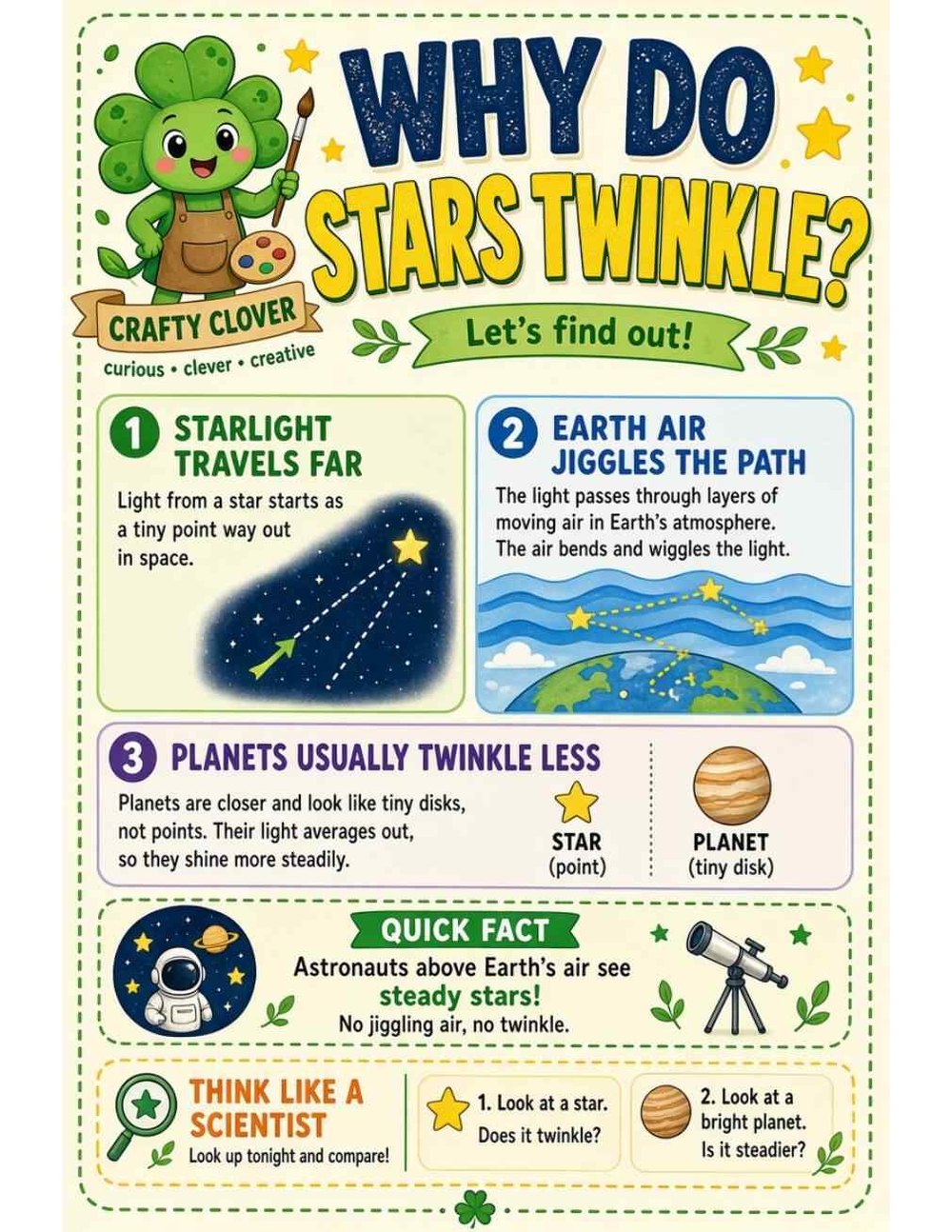
Page from A Million Whys Book 1
More fun facts
- Earth's air is clumpy. Different pockets of air bend a star's light in slightly different ways.
- Because the air is always windy and changing, the star's image keeps shifting, and it twinkles.
- Pockets of air at slightly different temperatures, always moving, bend the paths of light from space.
- This wiggly air, called turbulence, blurs pictures taken by telescopes on the ground.
- Some big telescopes shoot lasers into the sky to make glowing artificial stars. A bendy mirror then changes shape hundreds of times a second to cancel out the twinkle.
- Above Earth's atmosphere, in space, stars do not twinkle.
Sources: NASA Science, NASA Science
Questions kids ask
Do stars twinkle in space?
No. Twinkling happens because starlight passes through Earth's moving air.
How do astronomers stop twinkling?
Some telescopes use lasers and a mirror that bends hundreds of times a second to undo the blur.