
Book 1, Question 76
What If You Got Too Close to the Sun?
If you got too close to the Sun, its intense heat and radiation would be deadly, which is why spacecraft that visit it need heavy shields.
The Sun is a giant hot ball of gas, and heat and radiation rise fast the closer you get. That is why spacecraft stay far away and use shields. The page says the Sun's surface is about 5500 degrees C. You can feel the idea by comparing your hand close to a lamp and far from it, and remember to never stare at the Sun. The Sun gives us light and warmth from a safe distance!
Watch the videoWatch on YouTubeBuy on Amazon
Quick answers
How close has a spacecraft gone?
In December 2024, NASA's Parker Solar Probe flew just 3.8 million miles above the Sun's surface, at about 430,000 miles per hour.
What is the hottest part of the Sun?
The core is the hottest part of all, and the Sun's atmosphere is even hotter than its surface.
Sources: NASA Science, NASA Science, NASA Space Place
From the book
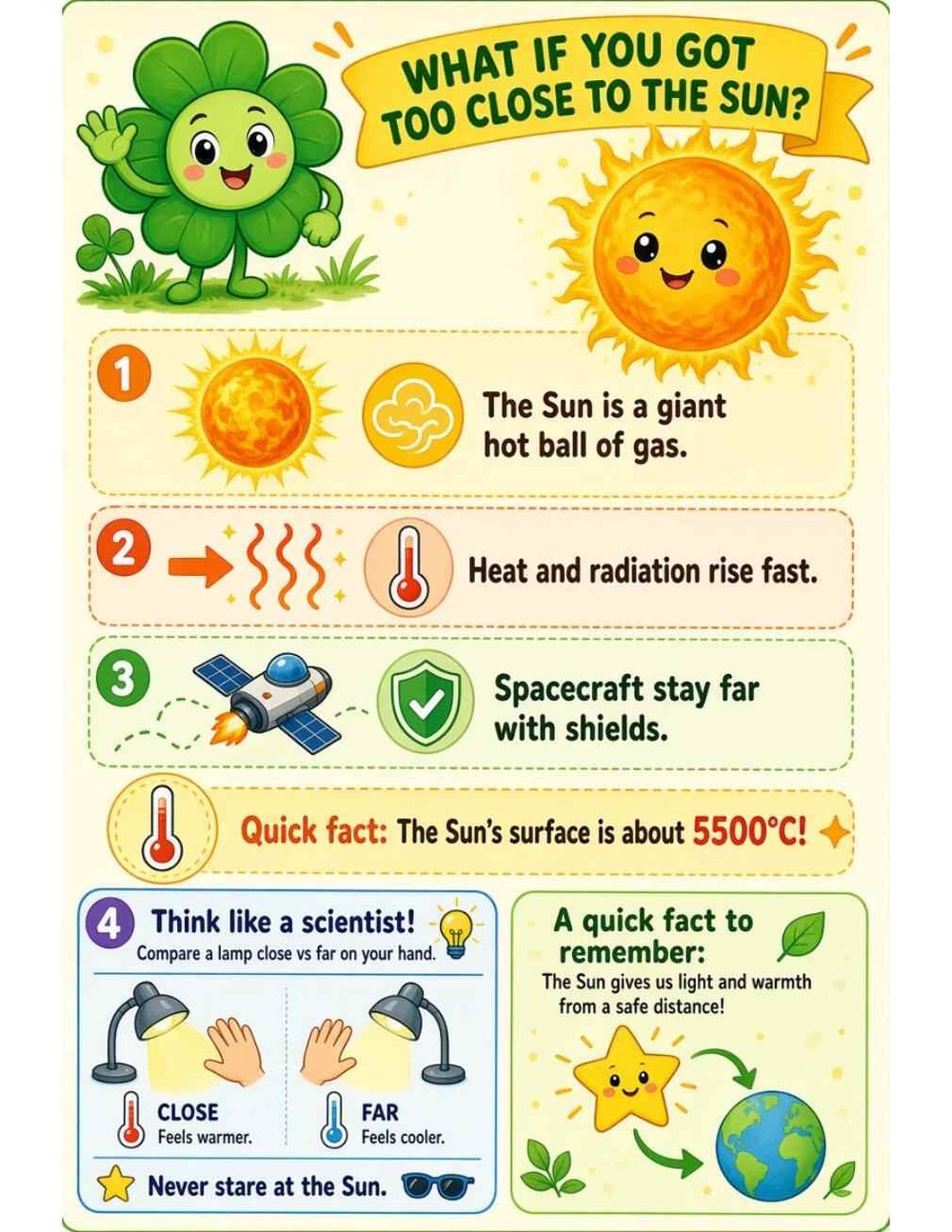
Page from A Million Whys Book 1
More fun facts
- NASA's Parker Solar Probe became the first spacecraft to fly through the Sun's upper atmosphere, called the corona, in 2021.
- In December 2024, Parker flew just 3.8 million miles above the Sun's surface, closer than any spacecraft before.
- On that pass it zoomed at about 430,000 miles per hour, faster than any human-made object has ever moved.
- Parker's path takes it well inside the orbit of Mercury, the closest planet to the Sun.
- The Sun's surface is about 10,000 degrees Fahrenheit, and its atmosphere is even hotter.
- The Sun's core is the hottest part of all, at about 27 million degrees Fahrenheit.
- Earth sits about 93 million miles from the Sun, which is a good thing, because being much closer would be far too hot.
Sources: NASA Science, NASA Science, NASA Space Place
Questions kids ask
Has anything ever touched the Sun?
NASA's Parker Solar Probe flew through the Sun's outer atmosphere, the corona, coming within 3.8 million miles of the surface.
Which part of the Sun is hottest?
The core, at about 27 million degrees Fahrenheit. Even the Sun's atmosphere is hotter than its surface.