
Book 1, Question 74
Why Do We Have Day and Night? Earth's Big Spin!
Day and night come from Earth spinning like a giant top. One full spin takes about 24 hours, and the half of Earth facing the Sun has daytime while the other half is in shadow. Sunset is your town rolling into shadow as it turns away from the Sun. The page says the equator rotates at about 1,600 km/h. Try a lamp and a ball at home to model how day and night happen.
From the book
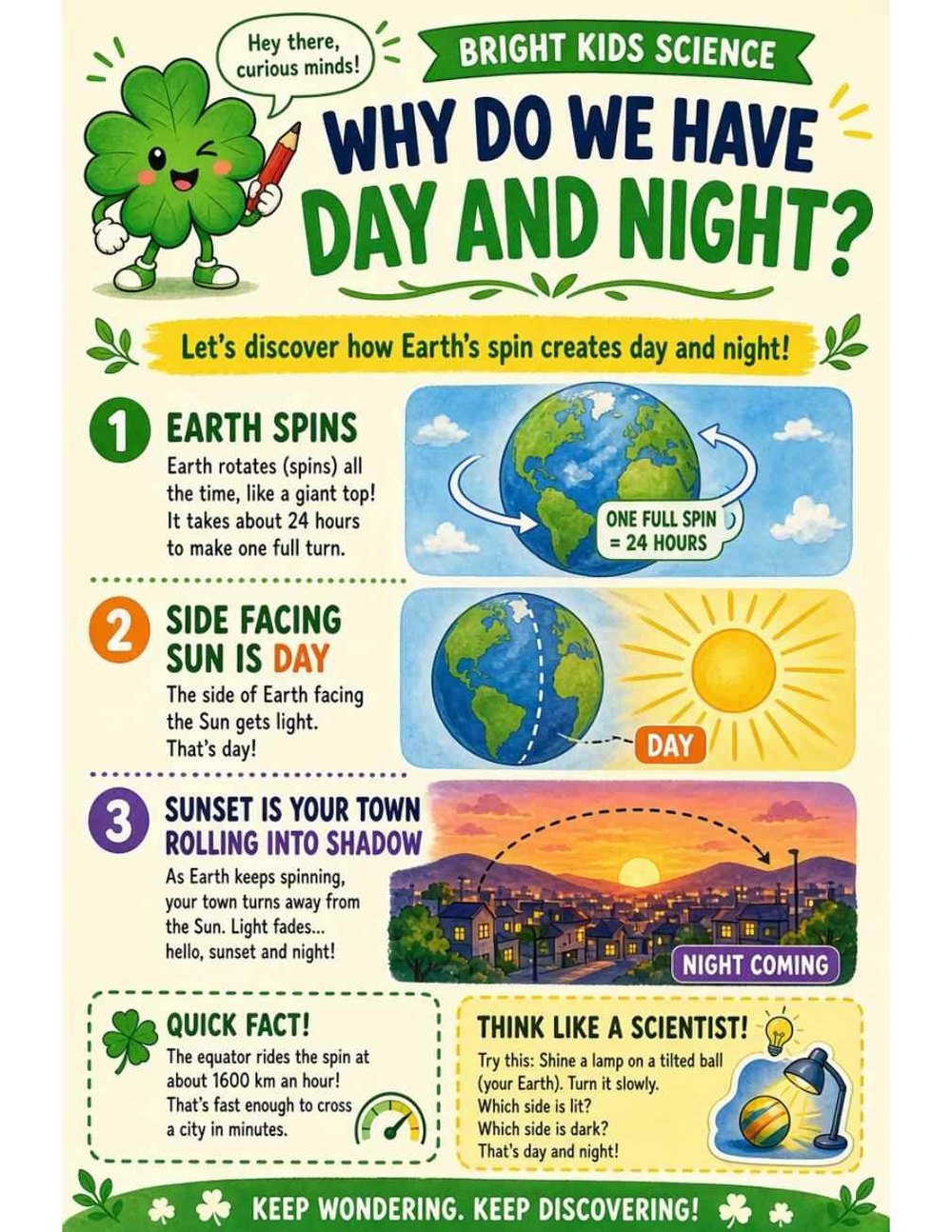
Page from A Million Whys Book 1
More fun facts
- Earth's axis is an imaginary pole running through the center of Earth from top to bottom. Earth spins around it once a day.
- Because Earth spins, every part of its surface gets some day and some night.
- Spinning around its own axis is called rotation. Going around the Sun is called revolution, and that takes about 365 days.
- Measured against faraway stars, one spin takes about 4 minutes less than 24 hours.
- Earth's spin makes it bulge a little at the equator, so it is not a perfect ball.
- Earth's axis leans a bit instead of standing straight up. That lean gives us seasons.
Sources: NASA Space Place, NASA Science
Questions kids ask
How long does Earth take to spin once?
About 24 hours compared to the Sun. Compared to faraway stars, it is about 4 minutes shorter.
Is Earth a perfect ball?
Not quite. Its spin makes it bulge a little at the equator.