
Book 1, Question 73
Why Does Compost Get Warm? Tiny Life, Big Heat!
A compost pile can be warm even on a cool morning, and tiny living things are the reason. Bacteria and fungi break down food scraps, leaves and yard waste, and as they munch they release energy that warms the pile. A damp, airy pile traps that heat like a cozy oven made of life, with a warm core and a cooler outer layer. The page says the core of a well-built compost pile can pass 60 degrees C (140 degrees F). Feel the outside of a scrap bin on a cool morning and notice where it is warmest.
From the book
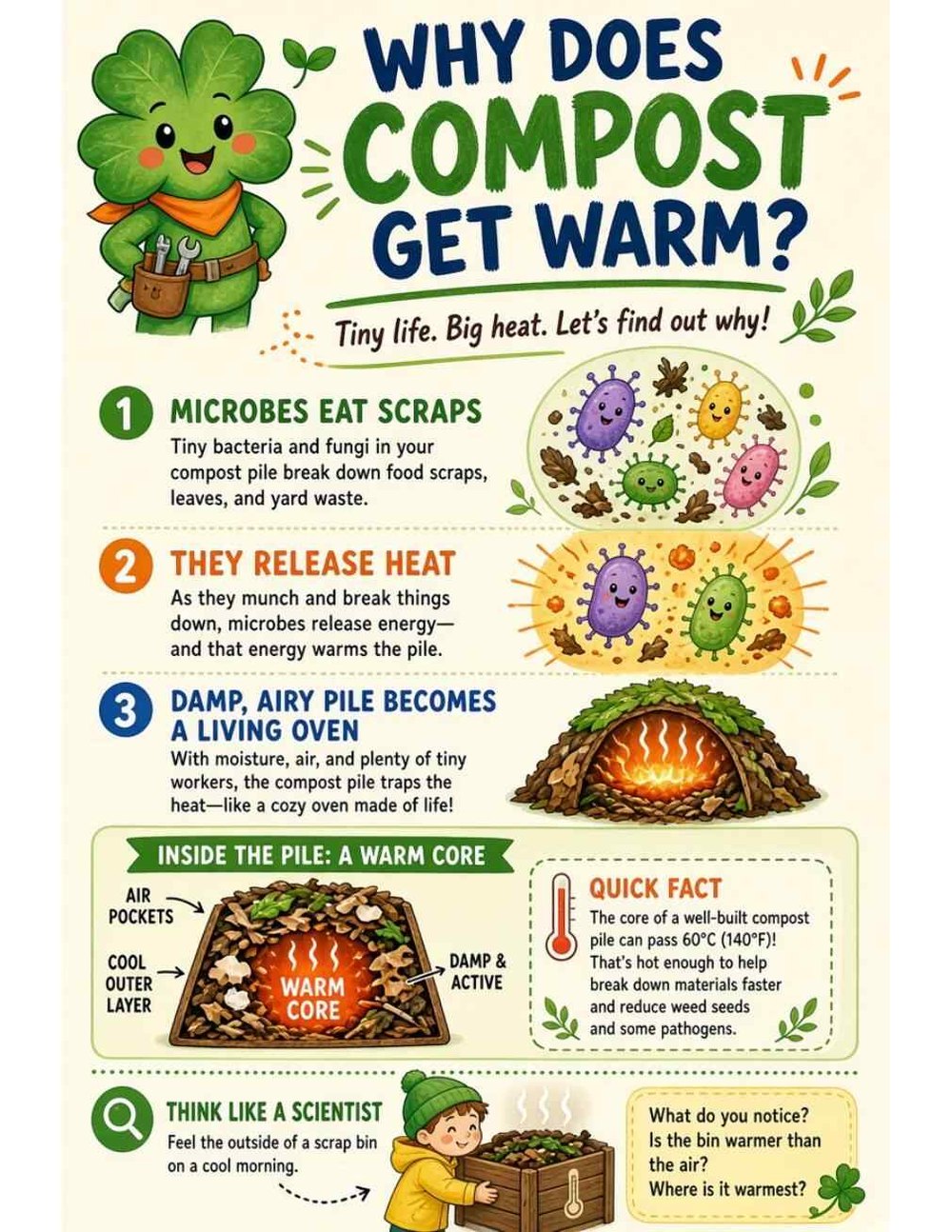
Page from A Million Whys Book 1
More fun facts
- As microbes break down scraps, they make carbon dioxide, water, heat, and a dark, crumbly material called humus.
- Bacteria make up 80 to 90 percent of the billions of tiny living things in a single gram of compost.
- Bacteria do most of the breaking down and make most of the heat in a compost pile.
- When the pile gets hotter than about 40 degrees Celsius, heat-loving microbes called thermophiles take over.
- At 55 degrees Celsius and above, many germs that harm people or plants are destroyed.
- Above about 65 degrees Celsius, many microbes die, so compost makers mix and air out the pile to keep it from getting too hot.
- Composting food and yard waste keeps it out of landfills, which helps cut greenhouse gases.
- Finished compost works like a natural fertilizer and helps soil hold on to water.
Sources: Cornell, National Geographic
Questions kids ask
What makes compost warm?
Billions of microbes, mostly bacteria, give off heat as they break down food and yard scraps.
Why do people stir compost?
Mixing adds air and keeps the pile from getting so hot that the helpful microbes die.