
Book 1, Question 64
Why Do Caves Form? Rain, Rock and Slow Drips!
Caves form when slightly acidic rainwater seeps into cracks and slowly dissolves rock like limestone, carving out underground passages.
Caves are nature's underground architecture. Rain picks up carbon dioxide and becomes a weak carbonic acid, which seeps into the ground and slowly dissolves limestone along cracks until they become channels and passages. Then mineral-rich water drips from the ceiling and leaves calcite behind, building stalactites that hang down and stalagmites that grow up. The page says a stalactite can take hundreds of years to grow just one inch.
Watch the videoWatch on YouTubeBuy on Amazon
Quick answers
What is limestone made of?
Layers of shells and skeletons of sea creatures from ancient, warm, shallow seas.
What is the difference between stalactites and stalagmites?
Stalactites hang from the ceiling, and stalagmites grow up from the floor where water drips.
How many caves are in U.S. national parks?
The U.S. National Park Service looks after more than 4,700 caves.
Sources: BBC, Science News Explores, National Park Service
From the book
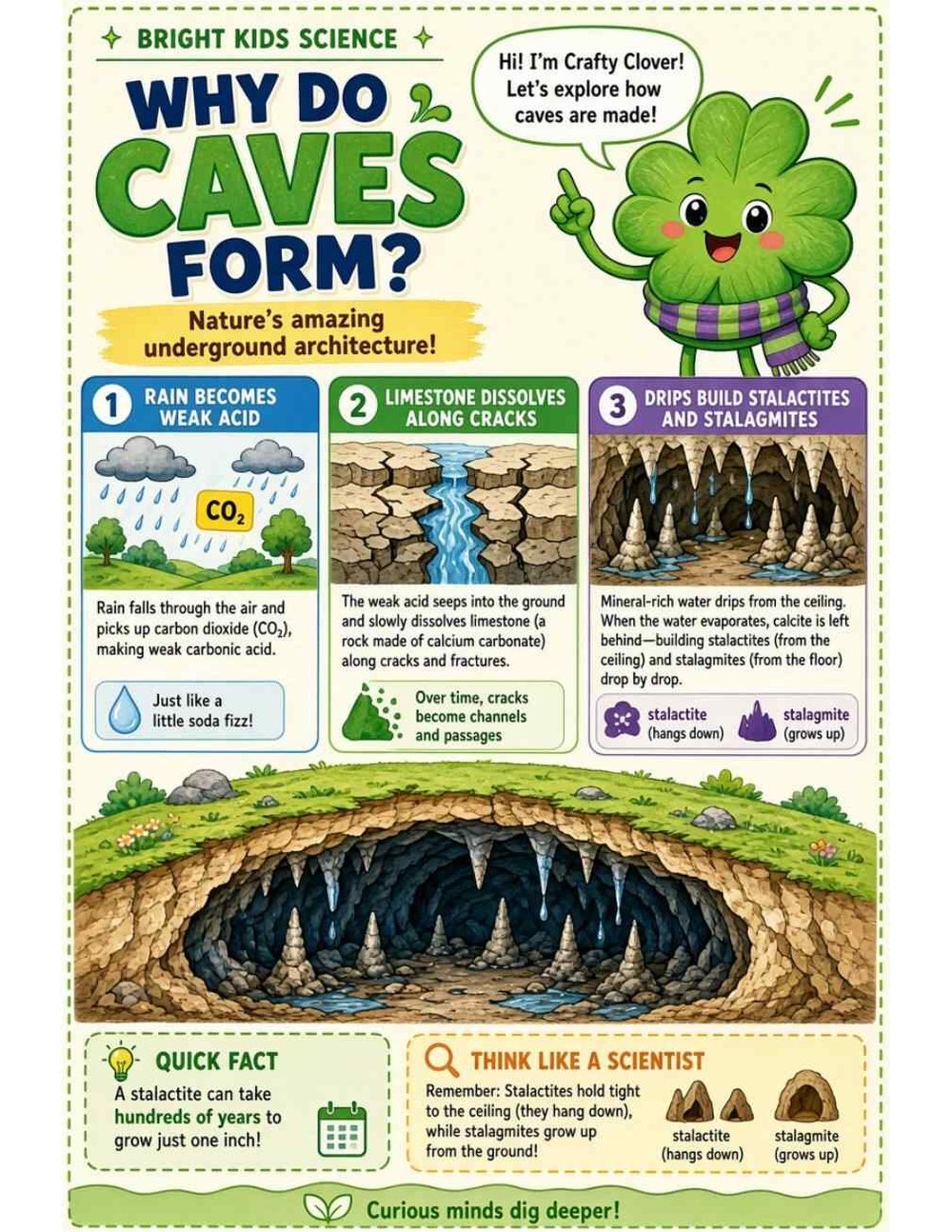
Page from A Million Whys Book 1
More fun facts
- Limestone is a rock made from layers of shells and skeletons of sea creatures from ancient, warm, shallow seas.
- Rainwater can dissolve limestone, carving potholes and caves.
- Stalactites hang from cave ceilings. They form when dripping water leaves minerals behind, building a rocky icicle over many years.
- Stalagmites grow up from the cave floor where water keeps dripping on the same spot.
- A memory trick: stalactites hold tight to the ceiling, and stalagmites might reach it someday.
- The U.S. National Park Service looks after more than 4,700 caves.
- At least four of those caves stretch more than 135 miles.
- Caves can preserve fossils and other clues to ancient life.
Sources: BBC, Science News Explores, National Park Service
Questions kids ask
What is the difference between a stalactite and a stalagmite?
Stalactites hang from the ceiling. Stalagmites build up from the floor.
How many caves are in U.S. national parks?
The National Park Service manages more than 4,700 caves.