
Book 1, Question 15
Why Can We Taste Sweet, Salty, Sour, Bitter and Umami?
We can taste sweet, salty, sour, bitter and umami because taste cells in taste buds on our tongue and mouth have receptors for each basic taste.
Your tongue is a tiny taste lab with five special jobs! Sweet, salty, sour, bitter and umami each help you learn something about your food, from energy to salt balance to warnings about acids or possibly harmful things. Tiny bumps on your tongue hold taste buds with special cells that detect these tastes and send signals to your brain. Your nose does most of the work of flavor, and you can test that with a grown-up by pinching your nose while tasting a jellybean.
Watch the videoWatch on YouTubeBuy on Amazon
Quick answers
Is there a tongue map?
No. Receptors for all the basic tastes are spread across the whole tongue.
Do taste buds heal?
Yes. Taste buds replace themselves about every 10 days, so injured ones usually heal on their own.
What is umami?
A savory, meaty or brothy taste, from Japanese words for delicious and taste. It comes from glutamate.
Sources: Cleveland Clinic, National Institutes of Health, Smithsonian Magazine, Science News Explores, National Geographic Education
From the book
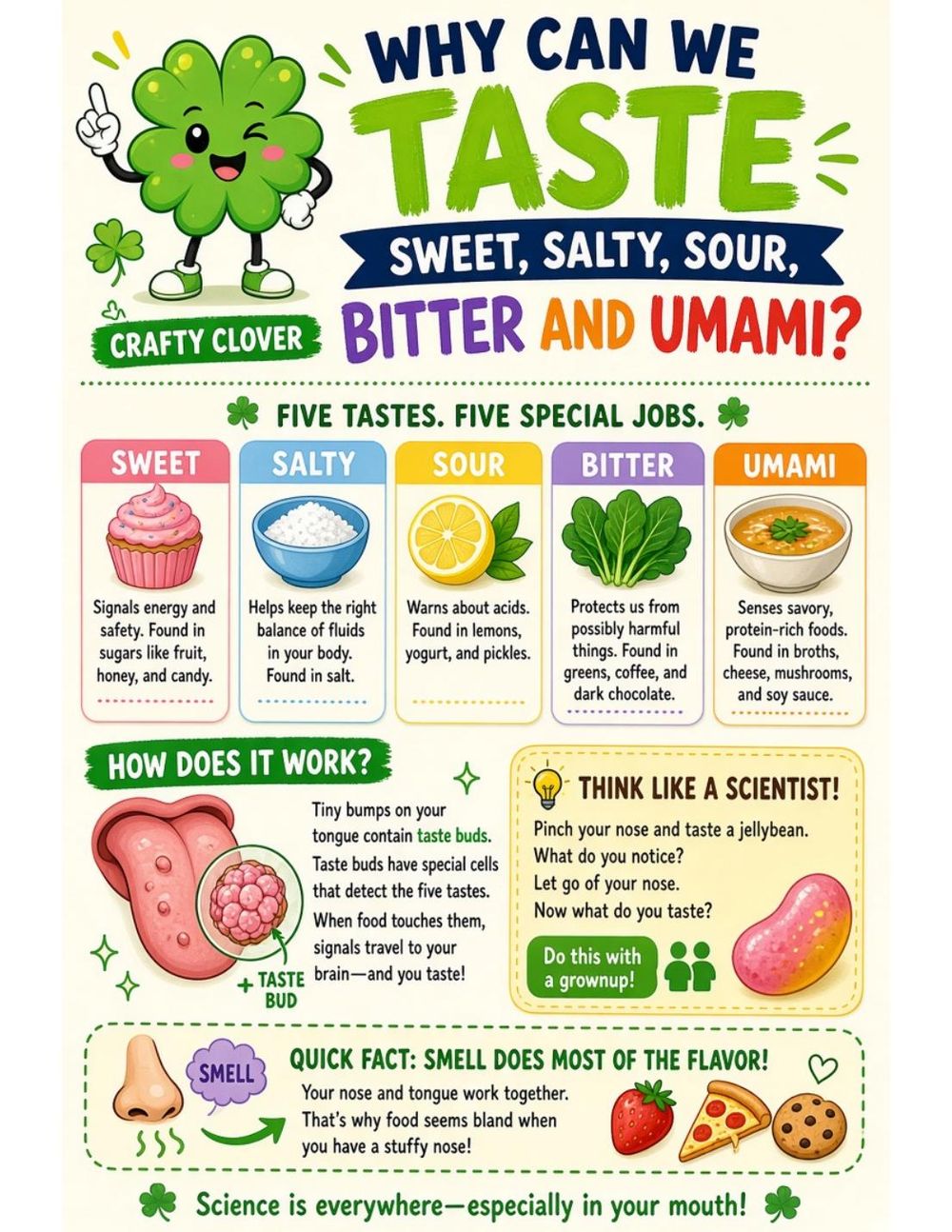
Page from A Million Whys Book 1
More fun facts
- Your taste buds sit inside the tiny bumps on your tongue. Those bumps are called papillae.
- Taste cells are not only on your tongue. They are also on the roof of your mouth and along your throat.
- Taste buds replace themselves about every 10 days, so injured taste buds usually heal on their own.
- That old tongue map with sweet at the tip and bitter at the back is wrong. Receptors for all the basic tastes are spread across the whole tongue.
- Umami comes from Japanese words for delicious and taste. Many people describe it as meaty or brothy.
- You taste umami when food turns on tongue receptors for a substance called glutamate.
- Many animals love umami, but penguins cannot taste it at all.
- A sweet taste can signal sugars, a sour taste can signal acids, and a bitter taste can warn about possible poisons.
Sources: Cleveland Clinic, National Institutes of Health, Smithsonian Magazine, Science News Explores, National Geographic Education
Questions kids ask
Is the tongue map true?
No. Receptors for sweet, salty, sour, and bitter are found all over the tongue, not in separate zones.
What does umami mean?
It comes from Japanese words for delicious and taste. It is the savory, brothy taste of glutamate.