
Book 1, Question 109
Why Do Boats Float? The Secret of Buoyancy!
A giant steel ship can float while a small rock sinks, and it is all about pushing water aside. Water pushes up on things, and that push is called buoyancy. A boat pushes a lot of water aside, and if the upward push beats its weight, it floats. Steel ships float because the hull is a big hollow shape, so more hollow volume means more water displaced and a bigger upward push. Float a clay ball and then shape the clay into a bowl to see it yourself!
From the book
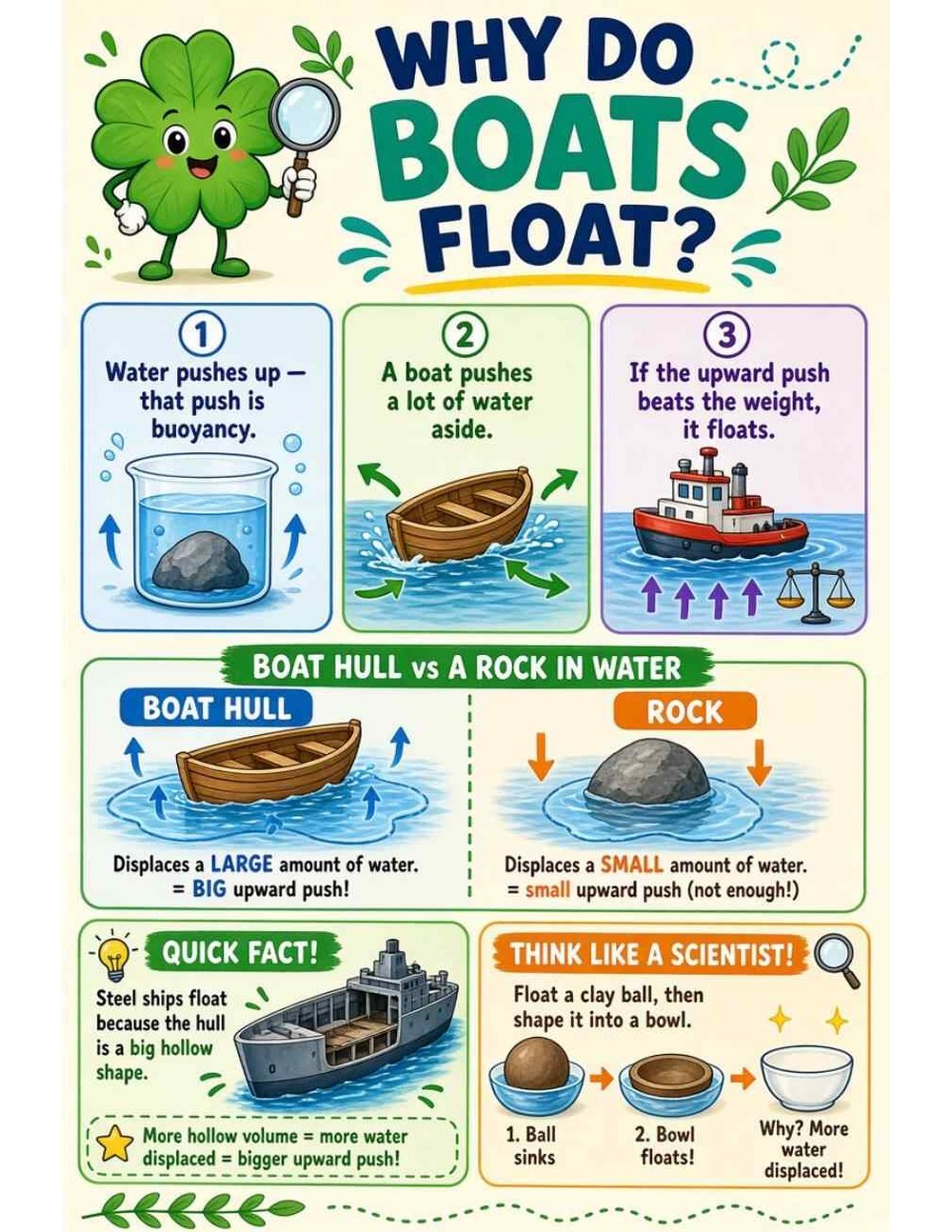
Page from A Million Whys Book 1
More fun facts
- The upward push of water is called the buoyant force, and it is there whether an object floats or sinks.
- The buoyant force equals the weight of the water an object pushes aside. This is called Archimedes' principle.
- Archimedes' principle explains why ships made of steel can float.
- Submarines rise and sink by changing what is inside their ballast tanks.
- Fish move up and down in the water using a body part called a swim bladder.
- In a NOAA activity, a flat sheet of foil soon sinks, but foil folded into a wide boat shape floats and carries weight.
- Your arms feel heavier when you get out of a bath because the water is no longer holding them up.
Questions kids ask
Why does a steel ship float?
Its shape pushes aside a lot of water, and the water pushes back up with a force equal to that water's weight.
How do submarines sink and rise?
They change what is inside their ballast tanks.