
Book 1, Question 102
Why Do Airplanes Fly? Lift, Thrust and Smart Wings!
Huge airplanes stay in the sky thanks to lift, thrust and smartly shaped wings. As a wing moves forward, its shape turns the air downward, and the air pushes the wing up, which is called lift. Engines keep air rushing over the wings, and the page says fast airflow means strong lift. Even a jumbo jet lifts off by moving tons of air every second. Blow across a paper strip held just under your lip and see if you can feel the lift!
From the book
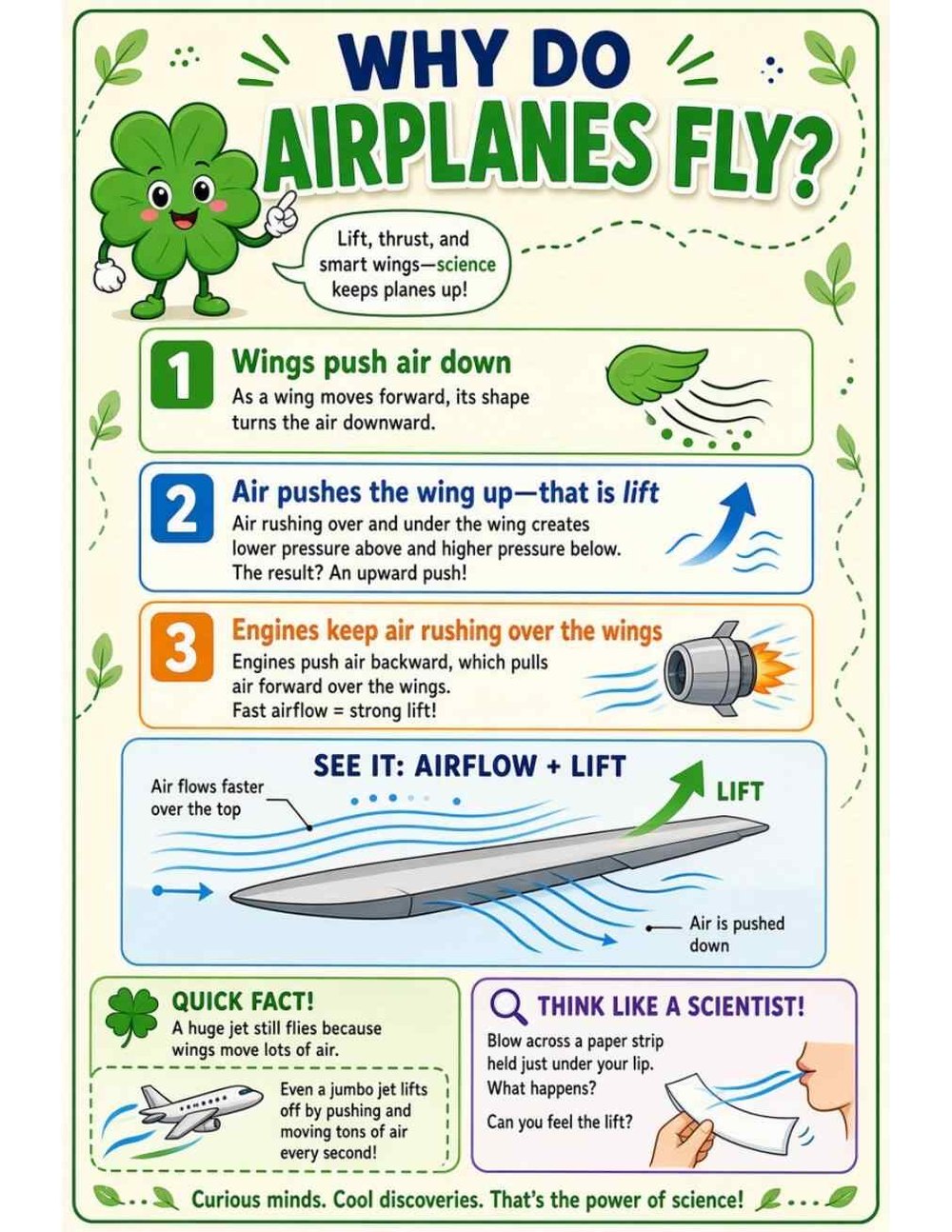
Page from A Million Whys Book 1
More fun facts
- Lift is the force that pushes up against an airplane's weight and holds it in the air.
- Every part of an airplane makes some lift, but on a normal airliner most of it comes from the wings.
- Wings push air downward, and the air pushes the wing up. That matches Newton's third law: every action has an equal and opposite reaction.
- The faster an airplane flies, the more lift its wings make.
- Tilting the wing more into the wind also makes more lift.
- Flaps on the wings stretch out during takeoff and landing to give extra lift at slower speeds.
- Scientists have argued for years about the best way to explain lift, and NASA notes that some popular explanations are wrong.
Questions kids ask
What part of an airplane makes the most lift?
On a normal airliner, the wings make most of the lift.
Why do planes use flaps?
Flaps give the wings extra lift for takeoff and landing.