
Book 1, Question 78
How Does the Sun Help Life on Earth?
The Sun does much more than light up our days. It gives us light and heat that keep Earth warm and cozy, and plants use sunlight, water and air to make their own food in a process called photosynthesis. Sun energy also helps drive the water cycle, makes wind blow and brings clouds, rain and weather. Animals eat plants, or animals that eat plants, so the page says almost all food energy starts as sunlight. Can you find one plant using the Sun today?
From the book
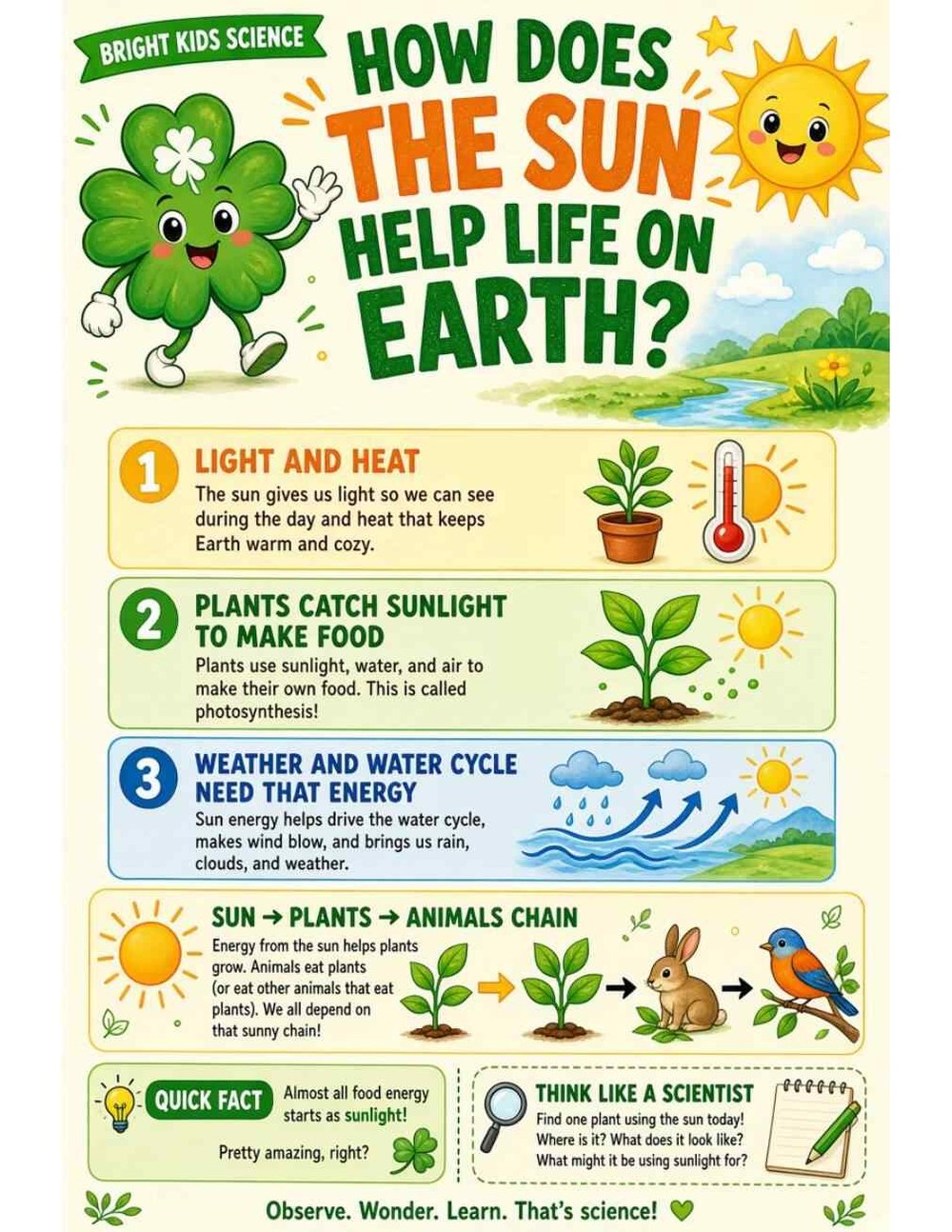
Page from A Million Whys Book 1
More fun facts
- The Sun is the closest star to Earth, about 93 million miles away.
- It is the source of the heat and light that make flowers bloom.
- Deep in the Sun's core, a process called nuclear fusion turns hydrogen into helium and makes energy.
- Energy made in the core takes about a million years to travel up to the Sun's surface.
- The Sun holds 99.8 percent of the mass of the solar system. Without it, there would be no solar system.
- Moonlight is really sunlight bouncing off the Moon.
- The Sun is a bright, hot ball made mostly of hydrogen and helium gas.
Sources: National Geographic Kids, NASA Space Place, NASA Science
Questions kids ask
How does the Sun make energy?
Nuclear fusion in its core turns hydrogen into helium and gives off huge amounts of energy.
How long does sunlight energy take to leave the Sun?
Energy made in the core takes about a million years to reach the surface.