
Book 1, Question 62
Why Do We Find Fossils? It Takes a Little Luck!
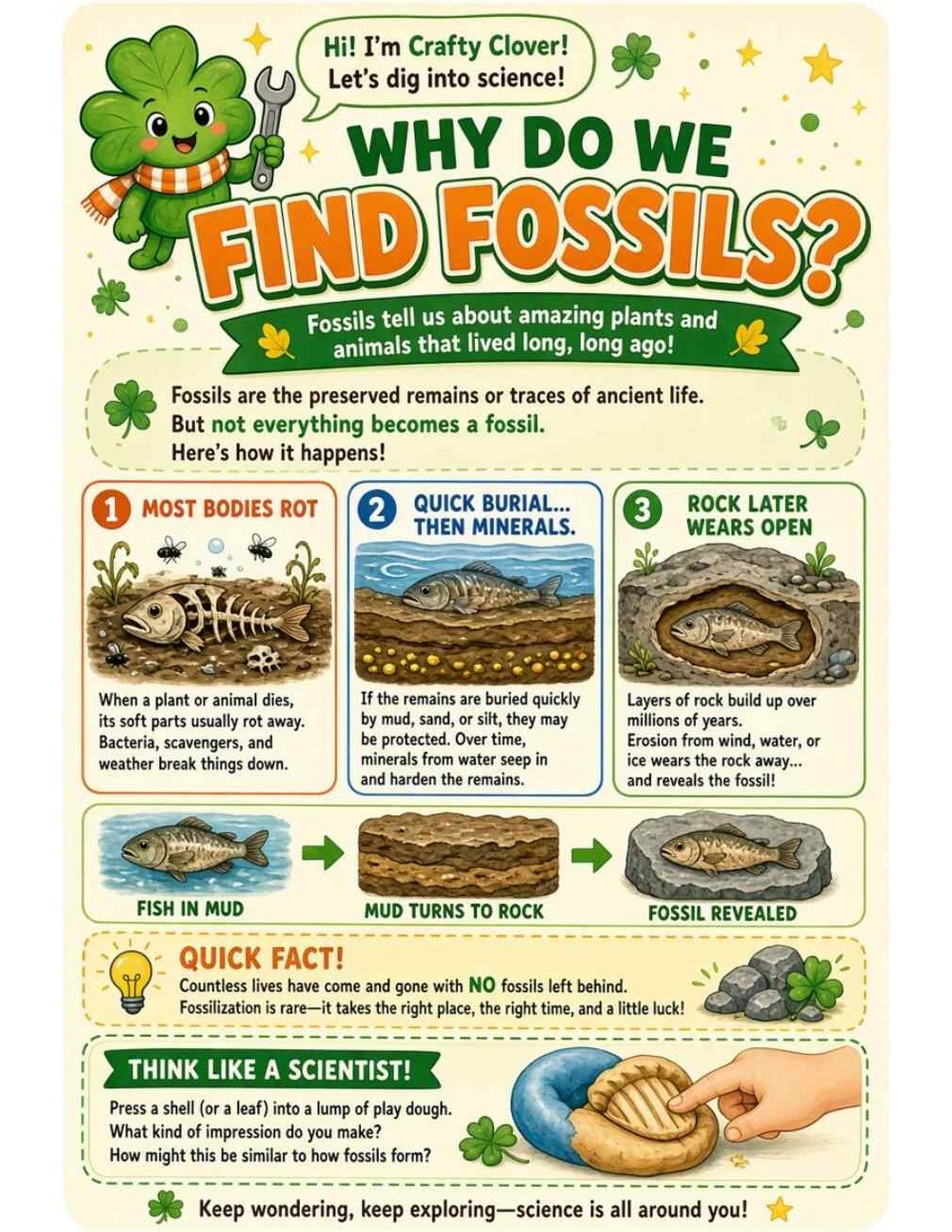
Fossils are the preserved remains or traces of ancient life, but not everything becomes one. When a plant or animal dies, its soft parts usually rot away. If the remains are buried quickly by mud, sand or silt, minerals from water can seep in and harden them, and much later erosion can wear away the rock and reveal the fossil. The page says fossilization is rare and needs the right place, the right time and a little luck. Press a shell into play dough to see how an impression is made.
From the book
Page from A Million Whys Book 1
More fun facts
- Fossils are not only bones and teeth. Footprints, burrows, and even dinosaur poop can become fossils.
- Fossil poop has a special name: coprolites.
- Fossils that show what animals did, like footprints, are called trace fossils.
- A fossil usually starts when a living thing is buried quickly in sediment, often at the bottom of a sea or lake.
- As more sediment piles on top, the weight slowly turns it into hard rock.
- Minerals can replace bone, shell, or tissue, and they can fill in the spaces between hard parts.
- Scientists who study fossils are called paleontologists.
- Fossils are a record of life on Earth from millions and even billions of years ago.
Sources: Science News Explores, Science News Explores
Questions kids ask
Can poop become a fossil?
Yes. Fossil poop is called a coprolite, and it is a kind of trace fossil.
Who studies fossils?
Scientists called paleontologists.