
Book 1, Question 53
Why Do Seasons Change? It's All About Earth's Tilt!
Summer, fall, winter and spring happen because Earth is tilted as it travels around the Sun. The tilt aims one half of Earth toward the Sun for part of the year, and more direct sunlight means summer. The page says Earth's axis stays tilted in the same direction all year long, and that seasons are opposite in the Northern and Southern Hemispheres. You can model it by shining a lamp on a tilted ball to compare direct and indirect sunlight.
From the book
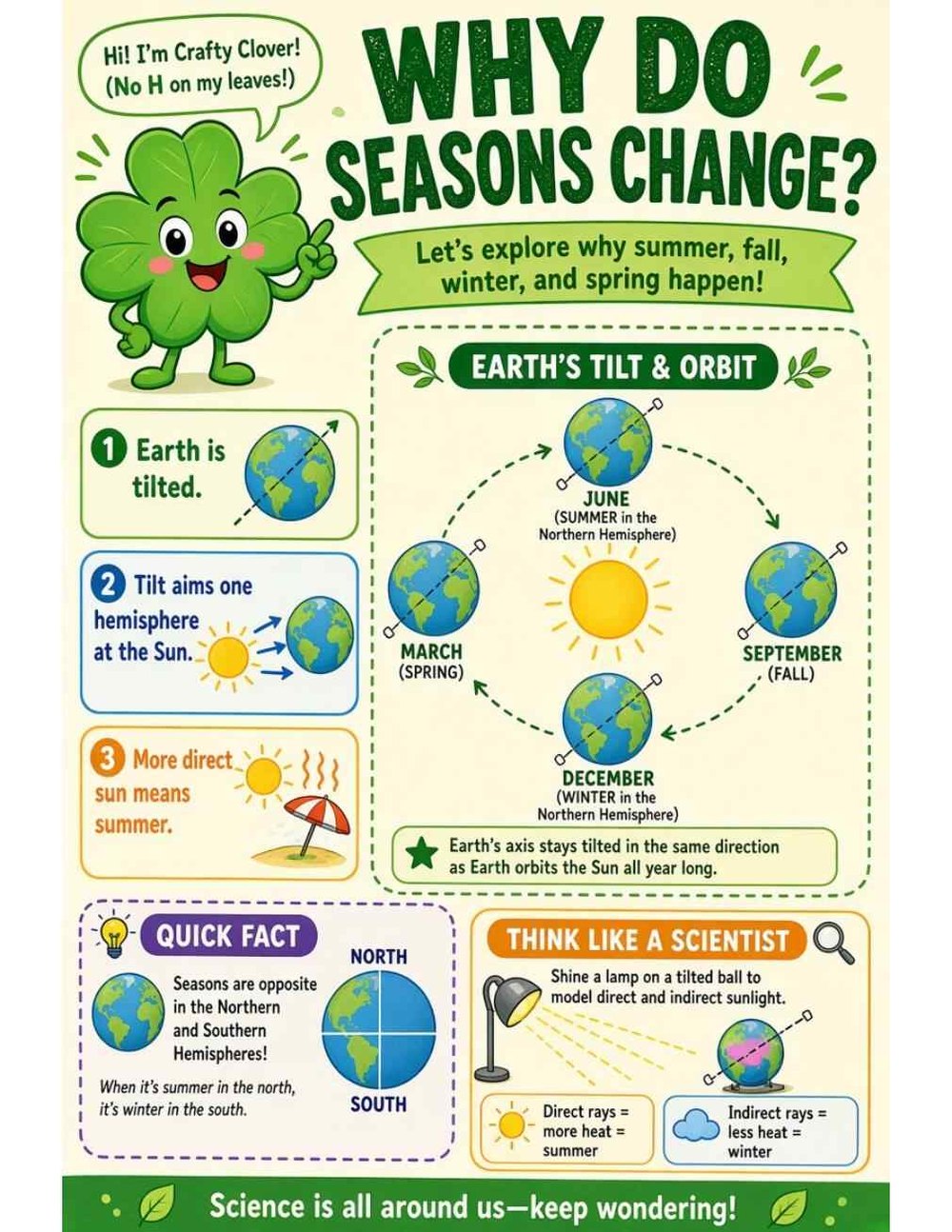
Page from A Million Whys Book 1
More fun facts
- As Earth goes around the Sun, its tilted axis always points in the same direction.
- Around June, the North Pole tilts toward the Sun. Around December, the South Pole does.
- When the North Pole tilts toward the Sun, more sunlight reaches the northern half of Earth, and it is summer there.
- The two halves of Earth have opposite seasons. When it is winter in the north, it is summer in the south.
- Many people think summer happens when Earth is closest to the Sun. That is a myth.
- In the Northern Hemisphere, winter actually comes when Earth is closest to the Sun, and summer comes when it is farthest away.
- Earth's distance from the Sun changes a little during the year, but not enough to make much difference to our weather.
Sources: NASA Space Place
Questions kids ask
Is summer when Earth is closest to the Sun?
No. In the Northern Hemisphere, Earth is actually closest to the Sun during winter. Seasons come from Earth's tilt.
Do Australia and Canada have the same seasons?
No. They are in opposite halves of Earth, so when it is winter in Canada, it is summer in Australia.