
Book 1, Question 33
Why Don't Woodpeckers Get Headaches? A Built-In Helmet!
Woodpeckers can peck thousands of times a day and stay headache-free, and the page shows why. Their skulls are full of tiny spaces that cushion the brain like a natural shock absorber, and a special tongue bone wraps around the skull like a seatbelt. The force of each peck also spreads through soft tissues and spongy bone instead of hitting the brain in one hard jolt. Try tapping a table and then a folded towel to feel the difference, but never bang your own head. Our brains are not built like a woodpecker's!
From the book
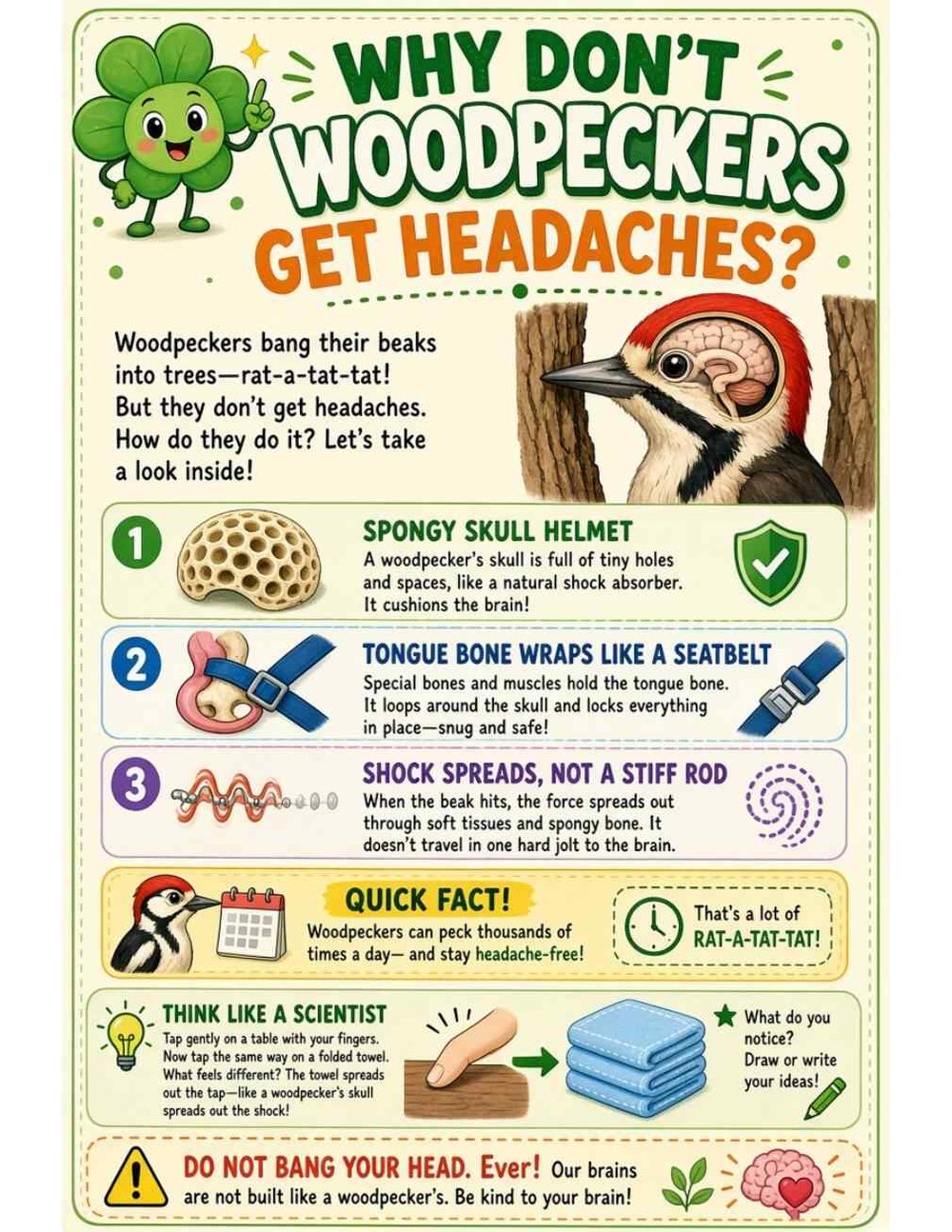
Page from A Million Whys Book 1
More fun facts
- There are more than 300 kinds of woodpeckers around the world.
- Woodpeckers peck to dig nest holes, find insects or sap, and make holes to store food.
- Acorn woodpeckers carve holes in trees just big enough to hold one acorn each. They are storing food for later.
- A woodpecker's brain is tiny, only about 0.07 ounce. A smaller brain has less mass, so it is less likely to be hurt by bumps.
- The outside of a woodpecker's skull is dense, hard bone, and the inside is porous bone.
- The force of each peck spreads around the skull to sturdy bone at the base and back, keeping pressure off the brain.
- Many pecks are glancing blows, not straight hits, which is easier on the bird.
- Some woodpeckers drum super fast on hollow trees to attract mates and defend their territory.
Sources: National Geographic
Questions kids ask
How do woodpeckers protect their brains?
Their tiny brains fit snugly in a skull with hard bone outside and porous bone inside, and the force spreads to sturdy bone at the back.
Why do woodpeckers peck?
To dig nest holes, find insects or sap, store food, and drum to attract mates and defend territory.