
Book 1, Question 23
Why Do We Get Fevers? Your Body's Smart Thermostat!
A fever can feel yucky, but it is not random. When germs sneak in, your brain raises your body's temperature set point, like turning up a thermostat. Many germs do not like heat, so warmer temperatures can slow them down and give your immune system a better chance. Resting lets your body put more energy into the fight, and grown-ups keep an eye on how high a fever goes. The page says a fever often means 38 degrees C (100.4 degrees F), though everyone's normal is a little different.
From the book
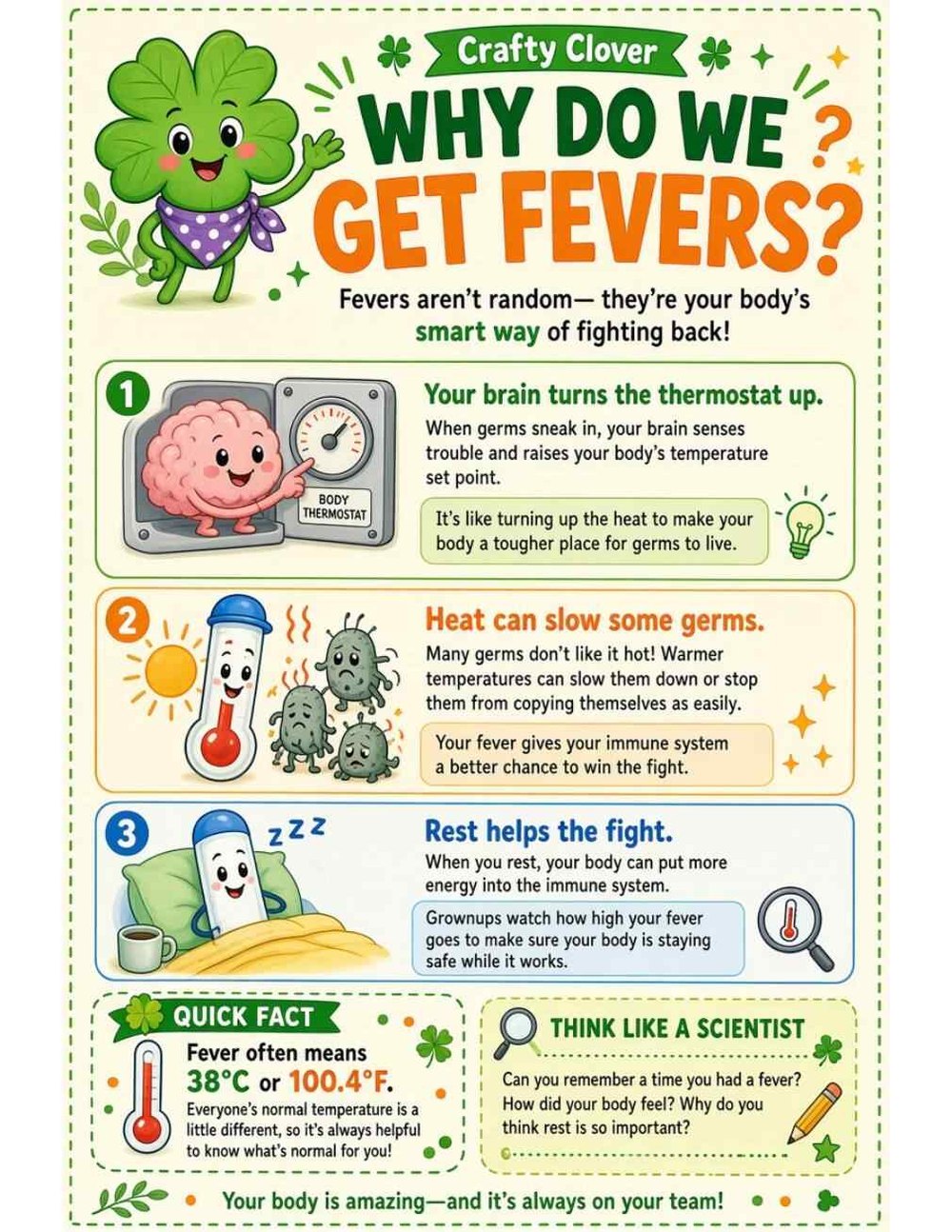
Page from A Million Whys Book 1
More fun facts
- Most doctors call it a fever when your temperature reaches 100.0 or 100.4 degrees Fahrenheit, which is about 38 degrees Celsius.
- The famous normal temperature is 98.6 degrees Fahrenheit, or 37 degrees Celsius. But each person's normal can be different by a degree or more.
- Babies and young children usually run a little warmer than older kids and grown-ups.
- A fever is often a sign that your immune system has switched on to fight an infection.
- Your body treats a virus or bacteria as an attack, and raising your temperature is part of its defense.
- Most fevers are not a serious concern.
Sources: Cleveland Clinic, Cleveland Clinic
Questions kids ask
What temperature counts as a fever?
Most doctors say a fever starts at 100.0 or 100.4 degrees Fahrenheit, about 38 degrees Celsius.
Is a fever bad?
Usually not. It is your body's normal way of fighting an infection. Tell a grown-up if you feel sick so they can check on you.