
Book 1, Question 6
Why Do We Have Fingerprints? Tiny Treads on Your Fingers!
Look closely at your fingertips and you will see a swirly pattern that belongs only to you. The raised ridges help your fingers grip things, a bit like the treads on a bike tire, and they help nerves feel textures and pressure. Fingerprints start to form before you are born, between weeks 10 and 16, and even identical twins have different ones. You can spot loops and whorls on your own fingers, and there is a fun fogged-glass experiment to try.
From the book
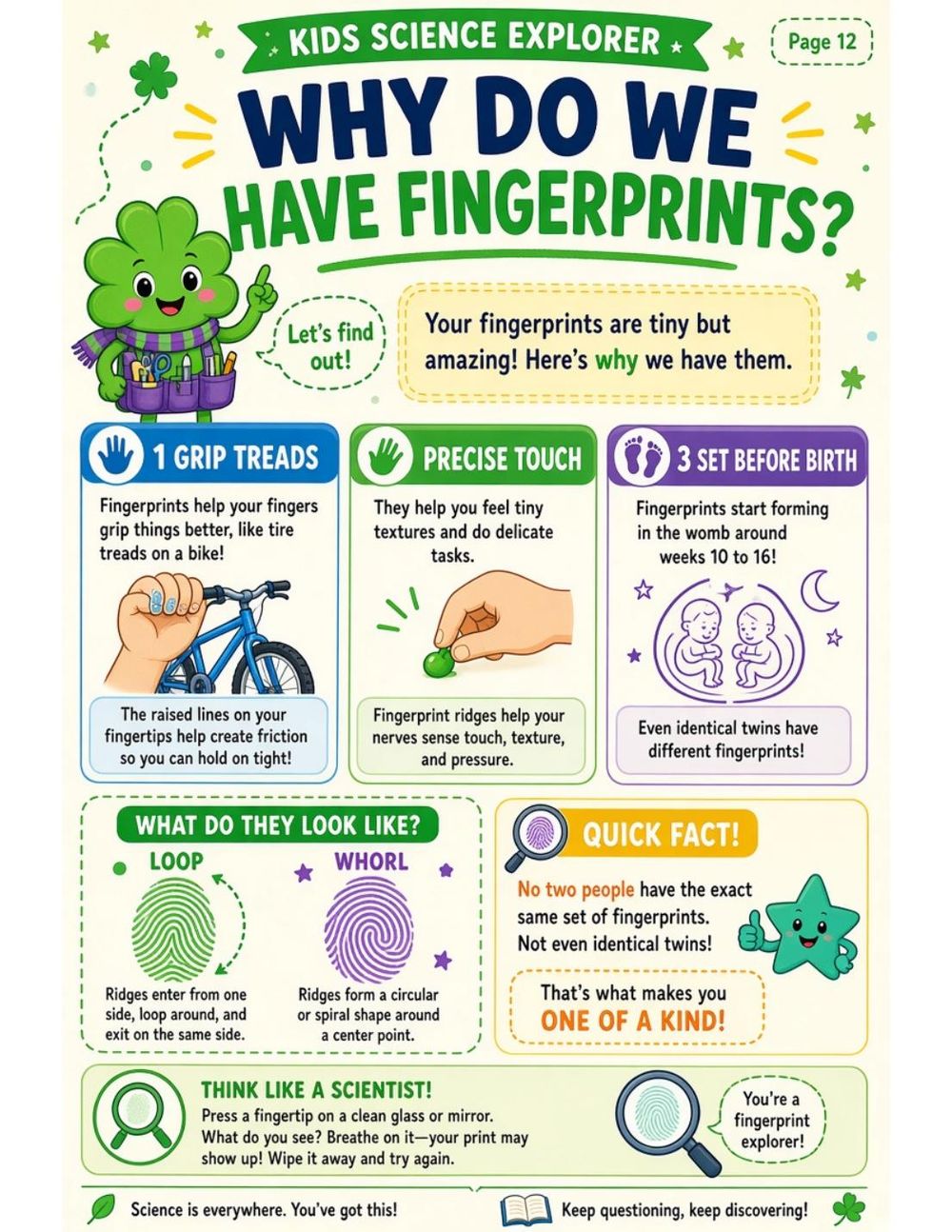
Page from A Million Whys Book 1
More fun facts
- Humans are not the only ones with fingerprints. Other primates and koalas have them too.
- No two people have the same fingerprints, and your prints last your whole life.
- Your fingerprints may spread out a tiny bit as you grow older.
- Scientists recently figured out how the ridges form. Three signaling molecules called WNT, EDAR, and BMP work together to make the stripe pattern.
- The ridge pattern follows a math idea called a Turing pattern, named after the scientist Alan Turing.
- For a long time people thought fingerprints help us grip. When researchers at the University of Manchester tested it, the results made them rethink that idea.
- Fingerprints can last a very long time. Ridge patterns from potters were found still pressed into 2,000-year-old pottery.
Sources: Science News Explores, Science News Explores, Smithsonian Magazine, Smithsonian Magazine
Questions kids ask
Do twins have the same fingerprints?
No. Each person's fingerprints are unique, so no two people share the same prints.
Do any animals have fingerprints?
Yes. Other primates and koalas have fingerprints too.